We offer a wide range of services for that fresh look, or just maintenance or updates to keep your home functioning and safe. Regardless of the size of the job, we have a craftsman that can tackle it. We offer a wide range of services for that fresh look, or just maintenance or updates to keep your home functioning and safe. Regardless of the size of the job, we have a craftsman that can tackle it.
Carpentry / September 21, 2026
Somebody knocks on your door in Bungalow Heaven or Madison Heights with a clipboard and tells you the original wood windows are “energy hogs” that have to go. Before you sign anything, here is how we actually decide between repairing and replacing a wood window on a Pasadena house built before about 1945, and why our answer, more often than not, is repair.
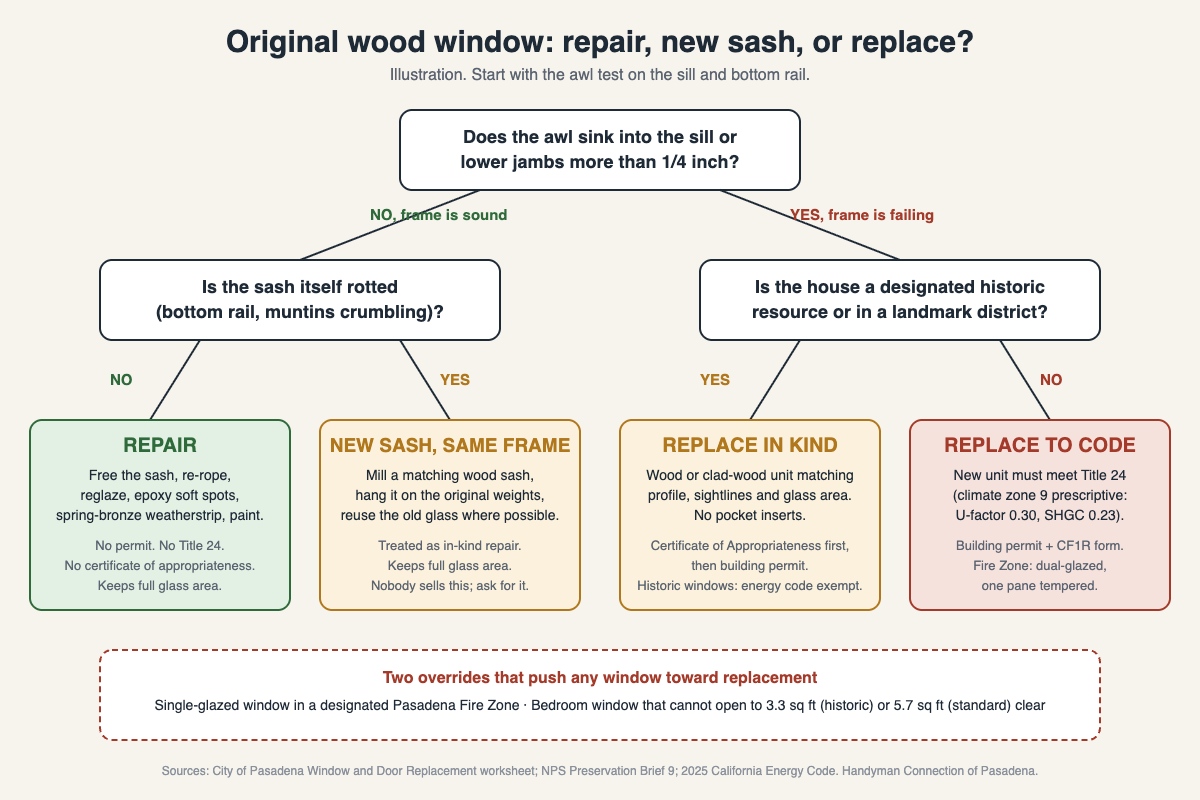
Repair the window if the frame and sill are sound, even if the sash is stuck, painted shut, rattling, or has a broken cord. Replace the sash (not the whole window) if the sash is rotted but the frame is fine. Replace the whole unit only when the sill and lower jambs are gone, or when the window can no longer meet a code requirement that the city will not waive. That third case is rarer than the window salespeople suggest.
Homeowners ask us what the difference is, and it is a fair question because the industry muddies it on purpose. A repair keeps the original frame in the wall and fixes what is broken: new sash cords or chains, reglazing with fresh putty, epoxy consolidation of soft spots, a new parting bead, spring-bronze weatherstripping, and paint. A sash replacement keeps the frame and swaps the moving sash for new wood sash milled to the same profile. A full replacement removes everything and sets a new unit. Then there is the thing most replacement companies sell in Pasadena: a pocket or retrofit insert, where a vinyl or fiberglass frame goes inside your existing frame. That is technically a replacement, but it shrinks your glass on every side by an inch or more and leaves the old frame in the wall to keep rotting behind the new one. On a 1912 Craftsman it also looks exactly like what it is. We do not recommend it on any house we would call historic, and we say that as a company that does carpentry, not window sales.
Wet the sill and the bottom corners of the lower sash and push an awl in at an angle. Sound old-growth fir or redwood, which is what most prewar Pasadena windows are made of, will resist and splinter in long fibers. Rot lifts out in short crumbly chunks. This comes straight from the National Park Service’s Preservation Brief 9 on wooden windows, and it is still the best field test there is. We check four spots: the outer sill, the joint where the sill meets each jamb, the bottom rail of the lower sash, and the muntin joints if it is a divided-light window.
Peeling paint alone tells you nothing about the wood underneath. Nine times out of ten in our experience it is just old oil paint that has lost its bond, and the wood beneath is fine. If you have already been reading about dry rot repair in Pasadena, the same logic applies: find the water path first, then judge the wood.
If the lower sash bottom rail is rotted through but the frame passes the awl test, we do not replace the window. A local mill can reproduce a sash in vertical-grain fir to match the existing profile, and it drops into the original frame on the original weights. You keep the wavy glass on the upper sash, keep your full glass area, and the city’s Design and Historic Preservation counter treats it as in-kind repair. This is the option almost nobody quotes because there is no product to sell.
These come from the City of Pasadena’s window and door replacement worksheet, which you fill out at the Permit Center on North Garfield, and they matter because they remove most of the “code forces you to replace” arguments.
Historic windows are exempt from the energy code. The worksheet states that if the building is a designated historic resource and the windows are considered historic, the windows are exempt from the California Energy Code requirements that apply to replacements. That means the Title 24 numbers a salesperson quotes you, which for Pasadena’s climate zone 9 are a prescriptive maximum U-factor of 0.30 and SHGC of 0.23 on replacement glazing under the 2025 California Energy Commission standards, do not apply to repairing your original windows at all. Repair never triggers Title 24. Replacement on a non-historic house does, and the CF1R form goes in with the permit.
Historic windows get a smaller egress requirement. A standard bedroom escape window needs 5.7 square feet of clear opening, 24 inches high and 20 inches wide. For historic windows on designated buildings, the city’s worksheet drops that to 3.3 square feet and 18 inches in either dimension. A freed-up double-hung with the lower sash raised almost always clears that.
Historic windows get a smaller light-and-ventilation requirement. Standard rooms need glazing equal to 8% of the floor area; historic windows only need 6% or 6 square feet. This is why the pocket-insert approach can backfire: it shrinks the glass, and on a small bungalow bedroom it can push a room out of compliance that was fine with the original window.
If your house is in a landmark district, the Certificate of Appropriateness comes before the building permit, and we wrote about how that sequence trips people up in our Bungalow Heaven permits article. In-kind repair of an existing window generally does not need a certificate. Replacement does. That alone shifts weeks of schedule and a stack of fees onto the replace side of the ledger.
Per window, a straightforward repair (free the sash, re-rope, reglaze a pane, weatherstrip, paint) is a few hours of labor and under a hundred dollars in materials. A full replacement with a wood or clad-wood unit that will pass historic review is a manufactured product plus installation, plus stucco or siding patching, plus interior trim, plus the permit and, in a district, the certificate. We are not going to print a per-window price here because our quotes depend on what the awl finds, and a number you read on a website that has never seen your sills is not a quote. What we will say plainly: on a sound-frame window, repair costs a fraction of replacement and lasts decades if the paint is kept up. The only place replacement wins on price is when the frame is already gone, because then repair means rebuilding the frame in place, which is slow, skilled work.
The energy-savings argument usually does not survive arithmetic either. A weatherstripped original window with an interior storm panel gets you most of the way to a dual-pane unit’s performance, and the payback on a full replacement measured against a Pasadena gas and electric bill runs well past the life of a vinyl frame in our sun. If comfort is the real goal, attic insulation does more per dollar than windows in almost every prewar house we have been in.
That order keeps most of the original material in the house, keeps your glass area, keeps you out of Title 24, and keeps the permit counter simple. It is also the sequence that the city’s own preservation guidance and the Secretary of the Interior’s Standards describe. If you want a second opinion on a replacement quote you have already received, or you just want someone to run the awl test with you, request a free estimate and ask for a window assessment. We are happy to tell you the windows are fine.
Almost always they can be fixed. Stuck, painted-shut, rattling, or broken-cord windows are repairs, not replacements. The only windows that truly need replacing are those whose sill and lower jambs have rotted through, windows with termite damage in the frame, single-glazed windows in a designated Pasadena Fire Zone, or bedroom windows that cannot be made to open to the escape size.
Repair keeps the original frame in the wall and fixes the sash, cords, glazing, weatherstripping, and paint. Sash replacement keeps the frame and installs new wood sash milled to match. Full replacement removes the whole unit. A pocket or retrofit insert is a replacement that leaves the old frame in place and shrinks the glass area, which we do not recommend on historic Pasadena houses.
On a window with a sound frame, repair costs a fraction of replacement: a few hours of labor and modest materials versus a manufactured unit, installation, stucco or siding patching, trim, a permit, and in a landmark district a Certificate of Appropriateness. Replacement only wins on price when the frame itself has failed. We quote after inspecting the sills, not from a chart.
In-kind repair of an existing window, including reglazing, re-roping, weatherstripping, epoxy repair, and paint, does not require a building permit or Title 24 compliance. Replacing a window does require a permit, and in a landmark district a Certificate of Appropriateness must be approved first.
No. The City of Pasadena’s window and door replacement worksheet states that windows considered historic on designated historic buildings are exempt from the California Energy Code requirements. Replacement windows on a non-historic house must meet the prescriptive limits for climate zone 9, a maximum U-factor of 0.30 and SHGC of 0.23 under the 2025 standards.
Handyman Connection of Pasadena · 110 S Rosemead Blvd, Pasadena, CA 91107 · (626) 744-0402 · CSLB License #992200. Serving Pasadena, Altadena, South Pasadena, Arcadia, San Marino, Sierra Madre, La Cañada Flintridge, Eagle Rock, Highland Park, Monrovia, and Temple City.

110 S Rosemead Blvd Suite G
Pasadena, CA 91107
License #992200

© Handyman Connection 2026 | Privacy Policy

 (626) 744-0402