We offer a wide range of services for that fresh look, or just maintenance or updates to keep your home functioning and safe. Regardless of the size of the job, we have a craftsman that can tackle it. We offer a wide range of services for that fresh look, or just maintenance or updates to keep your home functioning and safe. Regardless of the size of the job, we have a craftsman that can tackle it.
Carpentry / September 8, 2026
Every September the same call comes in: a bedroom or bathroom door that closed fine in June now drags on the jamb, or a front door that will only latch if you lift the handle and lean on it. And every September the same advice circulates on Nextdoor and in hardware-store aisles. Most of it is wrong for Pasadena specifically, because it assumes a climate we do not have and houses we do not live in.
Here are five things people are told to do about a sticking or non-latching door, and why each one tends to fail here.
This is the advice that does the most damage, and it is popular because it is true somewhere else. In a humid climate, doors swell in summer and a light pass with a plane fixes it. Pasadena in September is the opposite: it is the driest, hottest stretch of the year. Wood is at its smallest right now. A door that binds in September did not grow; something around it moved.
Plane it now and you have removed wood from a door at its minimum size. When the rains arrive in December and January and the humidity inside the house climbs, the door swells back to its normal dimension and you will have both a rub and, come next summer, a visible gap you cannot put back. Walk through enough 1920s houses in Bungalow Heaven or Madison Heights and you will find doors that have been planed several times over the decades, each time by someone chasing a seasonal symptom, until the door is noticeably narrower than its opening and no amount of weatherstrip hides it.
Our rule: no planing during the dry months unless the rub is clearly and permanently in the wood itself, which we confirm by reading the gap (below) first.
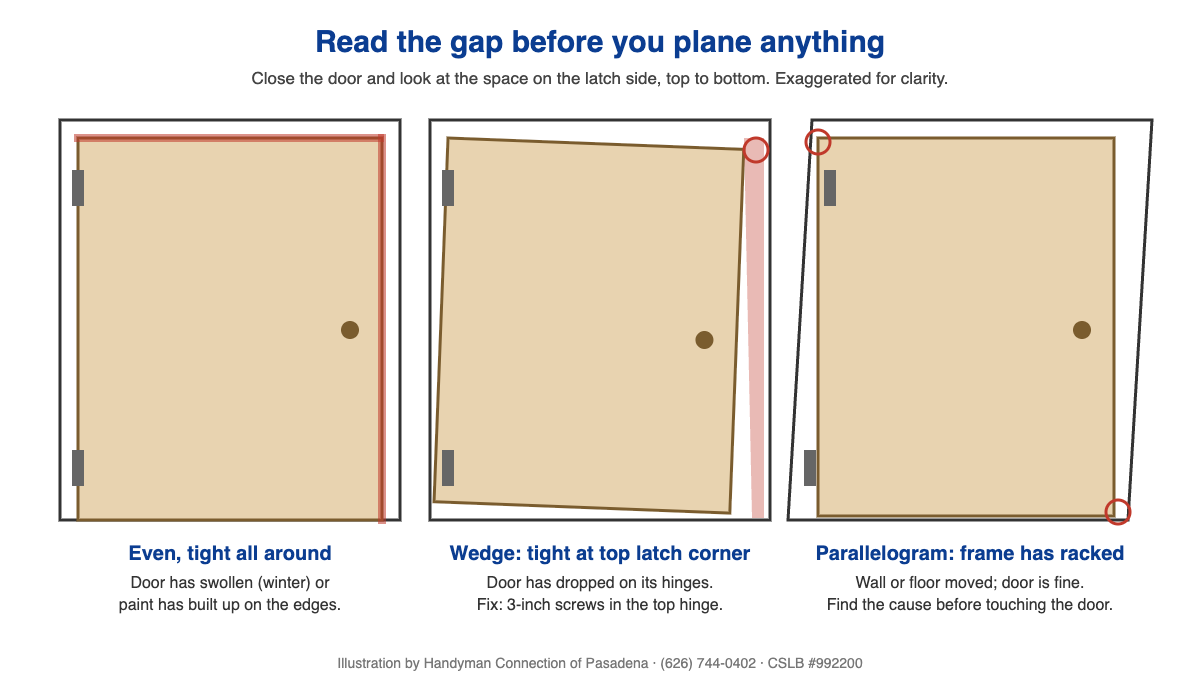
Close the door as far as it will go and look at the space between the door and the jamb on the latch side, top to bottom. The shape of that gap tells you the cause:
If the latch misses the strike by a hair, filing the strike opening a little is fine. If you have to lift the handle to make the door latch, the door has sagged, and moving the strike plate down to meet it just relocates the problem. The door keeps dropping, and in a year the strike gets moved again. Meanwhile the top of the door starts rubbing the head jamb, and people reach for the plane (see Myth 1).
The fix that actually holds is boring: replace the two short screws in the top hinge, jamb side, with 3-inch screws that reach through the jamb into the framing behind it. On an original 1920s door this is often all it takes, because those doors are solid vertical-grain Douglas fir and weigh close to twice what a modern hollow-core door does. Ninety years of that weight on three-quarter-inch screws is why they sag. A latch that keeps popping open is usually the same story from the other direction: the latch is only catching the edge of the strike because the door has moved.
Pasadena sits on the alluvial fan that spills off the San Gabriels, and most of it is well-drained, which is good news. But older raised-foundation houses in the flats south of Colorado Boulevard and around Daisy-Villa have thin, often unreinforced concrete stem walls and redwood mudsills that have been settling for a century. Add a mature oak or camphor tree pulling moisture out of the soil on one side of the house through a dry summer, and one corner drops a fraction more than the rest. The doors in that corner go out of square together.
That is the tell. One sticking door is a hinge or a paint problem. Two or three doors in the same corner all misbehaving at once, along with a fresh diagonal crack above a door or window, is a frame that has racked, and it is worth understanding why before doing anything to the doors. Our judgment on this: do not buy a foundation inspection on the strength of one door, and do not let anyone re-hang three doors in a corner that is still moving. That crack is also usually the reason people call about plaster and drywall cracks and stucco cracks at the same time; they are one problem, not three.
What we will not do is re-hang a door into a frame that is still moving. You get a door that fits this month and sticks again in March.
Soap on a drawer runner is a fine old trick. On a door it hides the symptom for a week, and wax or soap worked into a painted jamb means the next time that jamb is painted the paint will not stick. Slamming a heavy fir door into a dropped hinge is worse: it loosens the screws further and, on the old cast hinges, can crack a knuckle. If the door needs a shove to close, that is the door telling you the hinge screws have let go.
For a 1970s door in a Hastings Ranch ranch house, a pre-hung replacement is often the right call, and we install plenty of them. For a pre-war house it is usually the wrong one, for three reasons.
First, the jamb width. Stock pre-hung units are built for a 4-9/16-inch wall (2×4 framing with drywall both sides). Pasadena’s plaster-and-lath walls are thicker, so the new jamb sits short of the wall surface and has to be extended, which is where the “quick swap” turns into a full day of trim work. Second, the door itself: an original five-panel fir door is worth keeping. A hollow-core six-panel from the shelf is lighter, sounds hollow, and looks wrong beside the originals down the hall. Third, if it is an exterior door on a house in one of the city’s landmark districts, replacing it can trigger design review before a permit will be issued; we covered how that sequence works in the Bungalow Heaven permit article.
Our preference on old doors is nearly always to repair: re-set the hinges, shim or re-mortise, and only trim wood once the door is hung square and we can see where the true rub is. That is carpentry work, not a replacement job, and it is the kind of small, specific repair a lot of contractors will not come out for. We will; it is most of what we do in the small-jobs part of the schedule.
People ask what it costs to fix a sticking door and want a number. Honest answer: the price is driven almost entirely by which of the three gap patterns you have, so we quote after looking, not before.
A dropped hinge is the quickest fix on the list, often finished in well under an hour, and it is worth bundling with the other small things on the house so the visit earns its trip charge. A door that has been planed too many times over the years needs an edge strip glued and fitted, then repainted, which is a longer job and usually a painting touch-up afterward. A racked frame is the one where the door is the last thing we fix, not the first. If the door has been swollen every winter for years, there is a fair chance moisture is getting to it, and it is worth checking for dry rot at the bottom of the jamb while someone is already there. If you want a number for your door, request an estimate and describe the gap; it helps us tell you whether it is a ten-minute or a half-day visit before we come out.
Go around the house now, while everything is dry and at its smallest, and note which doors close cleanly and which drag. Anything dragging in September is not a moisture problem and is worth fixing before the winter swelling makes it worse. Anything that closes fine now but sticks in January is a moisture problem, and January is when to deal with it, not now. Put it on the list alongside the rest of your fall maintenance, and if you are hardening the house before the Santa Ana season, check that exterior doors seal against the weatherstrip while you are looking at ember-resistant vents and screens.
For doors that also need to be easier to use, wider, or lever-handled for someone with limited grip, that same visit is a natural time to talk about aging-in-place modifications. And if the sticking door happens to be a sliding patio door rather than a swinging one, that is a different animal entirely; see our sliding door roller and track guide.
Handyman Connection of Pasadena, 110 S Rosemead Blvd, Pasadena, CA 91107. (626) 744-0402. CSLB License #992200. Serving Pasadena, Altadena, South Pasadena, Arcadia, San Marino, Sierra Madre, La Cañada Flintridge, Eagle Rock, Highland Park, Monrovia and Temple City.
Close the door and look at the gap on the latch side. An even, tight gap all around means the door has swollen or paint has built up; a wedge-shaped gap tight at the top latch corner means the door has dropped on its hinges; a gap that has shifted into a parallelogram means the frame has racked. In Pasadena’s dry September, sticking is almost never swelling. The most common fix is replacing the short screws in the top hinge with 3-inch screws that reach the framing.
It depends on which of the three causes you have, so we quote after looking rather than from a table. A dropped hinge is a quick fix, often well under an hour. A door that has been over-planed needs an edge strip fitted and repainted, which is longer. A racked frame means the door is the last thing to fix, not the first. Request an estimate and describe the gap shape and we can usually tell you which category you are in before the visit.
If the gap is wedge-shaped, driving 3-inch screws into the top hinge is a reasonable DIY job. If the door is an original solid fir door, if it has been planed before, if several doors in one corner of the house are sticking at once, or if it is an exterior door in a landmark district, have someone look at it before removing any wood.
The door has sagged on its hinges, so the latch is arriving below the strike opening. Lifting the handle raises it back into line. Moving the strike plate down relocates the problem; re-securing the top hinge with long screws fixes it.
Usually the latch is only catching the edge of the strike because the door has moved slightly, or the strike is set too far out. Fix the hinge first, then adjust the strike if it still pops.
One sticking door almost never does. Two or three doors in the same corner going out of square at once, with a fresh diagonal crack above a door or window, is a racked frame and worth investigating before any door work. Do not buy a foundation inspection on the strength of one door.

110 S Rosemead Blvd Suite G
Pasadena, CA 91107
License #992200

© Handyman Connection 2026 | Privacy Policy

 (626) 744-0402