We offer a wide range of services for that fresh look, or just maintenance or updates to keep your home functioning and safe. Regardless of the size of the job, we have a craftsman that can tackle it. We offer a wide range of services for that fresh look, or just maintenance or updates to keep your home functioning and safe. Regardless of the size of the job, we have a craftsman that can tackle it.
Maintenance / October 12, 2026
Every October the same thing happens. The first storm shows up on the forecast, someone buys a case of caulk, and by Sunday afternoon every seam on the house is sealed shut. Then the first real rain comes in November and a window that never leaked before starts dripping onto the sill.
Caulk keeps water from getting in. But houses are also built with paths that let water get back out, and a tube of sealant can’t tell the two apart. Here are five pieces of advice we hear a lot in Pasadena, Altadena and the rest of the San Gabriel Valley, and why each one tends to backfire on the stucco and wood-sided houses you see here.
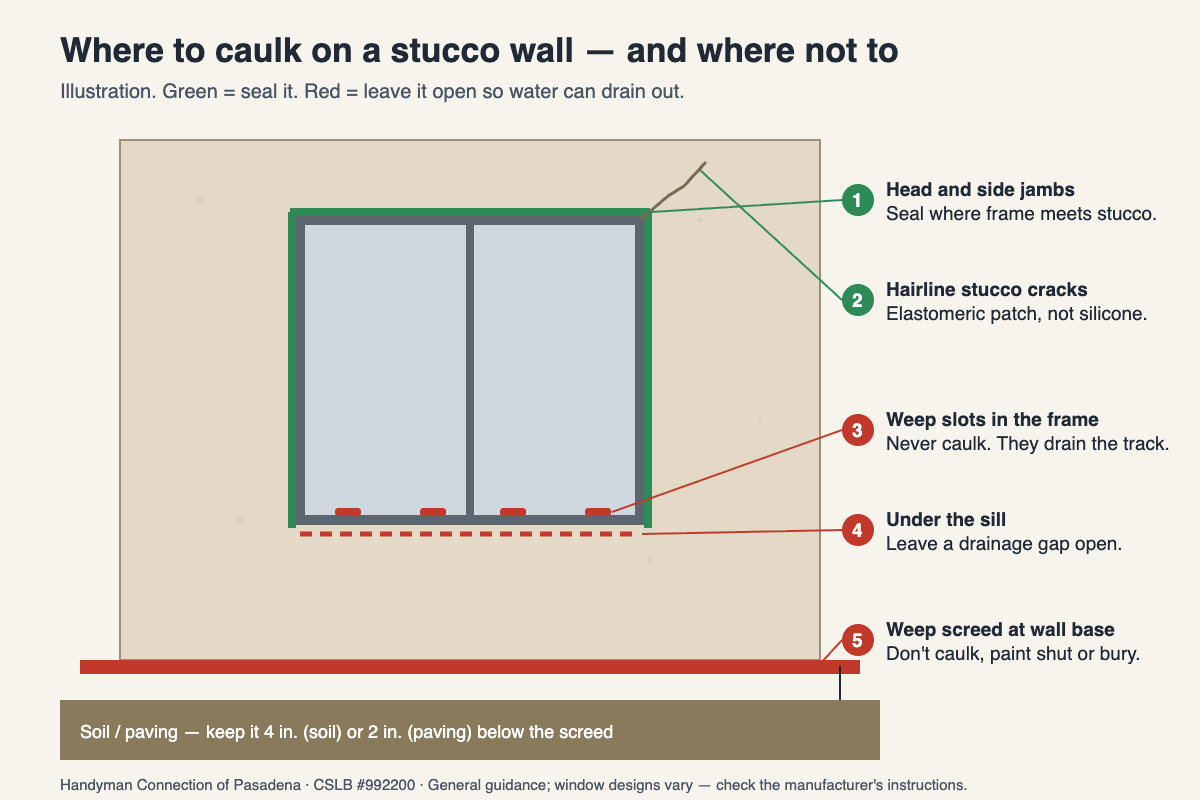
Most aluminum and vinyl windows, including the sliders that went into thousands of Pasadena houses in the 1970s through the 2000s, have small slots along the bottom of the frame. Those are weep holes. Rain that gets past the glass runs down into the sill track and leaves through them. Caulk them shut and the track fills like a gutter, then overflows inward.
The same goes for the bottom edge where the window meets the stucco. Builders often leave that joint open on purpose so any water that gets behind the frame can drain. What you should seal: the top (head) and the two sides (jambs). If your window sits in a stucco opening, that is about 90% of the job. Bob Vila has a clear explanation of how weep holes work if you want to see one up close.
If you have the original wood windows common in Bungalow Heaven and Garfield Heights, the rules are different: there are no weep slots, and the weak spots are glazing putty and the joint between the sill and the casing. We covered that in our guide to repairing original wood windows.
That perforated metal edge where the stucco stops, just above the dirt or the patio, is called a weep screed. It is the drain for the whole wall. Water that soaks through stucco runs down the building paper behind it and exits there. The California Residential Code (section R703.7.2.1) requires it to sit at least 4 inches above soil and 2 inches above paving for exactly that reason.
The two ways we see weep screeds defeated are caulking them to the foundation “to keep bugs out” and burying them under a raised planter bed or new pavers. Either one keeps water against the bottom of the wall, where the wood sill plate is. That is how a cosmetic stucco crack turns into a dry rot repair. Our opinion: if a landscaper has piled mulch up over your screed, pulling it back is a better use of a Saturday than any caulking job.
One Pasadena-specific note: many stucco houses built before the 1950s don’t have a weep screed at all. That is not a defect you need to fix, but it does mean keeping soil well below the stucco matters even more.
New caulk doesn’t bond well to old caulk, and it bonds to silicone hardly at all. A fresh bead over a cracked one looks great for a season, then peels away and leaves a channel that guides water straight into the joint. Cut the old bead out with a utility knife or a caulk removal tool, clean the joint, and let it dry before you start.
Joint depth matters too. A gap deeper than about half an inch needs backer rod pushed in first, so the sealant sticks to the two sides and not the bottom. A big blob of caulk stuffed into a deep gap cracks down the middle the first time the wall heats up in the afternoon sun.
Silicone holds up well against UV and water, which is why it gets recommended for exterior work. Its problem is that paint won’t stick to it, and residue left behind is hard to get off. On a painted Craftsman with wood trim and lap siding, that’s a big deal: a silicone joint becomes a shiny stripe that peels every time you repaint.
For painted wood, use a paintable exterior sealant (a polyurethane or a hybrid polymer). Keep silicone for glass, metal and other places that will never see a brush. If you’re planning exterior painting in the next year or two, this choice will matter to your painter. Fine Homebuilding’s breakdown of paintable caulks is a good reference.
Lap siding and horizontal trim are designed to shed water the way roof shingles do: each piece overlaps the one below. If you caulk the bottom edge of a lap board, or the underside of the drip cap over a window or door, water that gets behind it has nowhere to go. Seal the vertical joints, where trim meets siding at the sides, and the top edges. Leave the bottom edges open.
That same thinking applies to stucco cracks. Hairline cracks are normal in Pasadena. Our soils and the occasional earthquake make sure of that. Fill those with an elastomeric patch that takes paint and texture, not a bead of silicone. Diagonal cracks spreading from the corners of windows or doors are a different story. They point to movement, and they deserve a look before the rain. Our stucco repair guide covers how to tell the two apart.
Inside the house, the rules change completely. Around tubs and showers you do want a continuous seal, and that’s where a good silicone belongs. If yours is mildewed or pulling away, that is a home maintenance job worth doing before guests arrive. We have a list of things that tend to fail in front of company.
Caulking is a reasonable DIY job on a one-story house. Call a pro if you see soft or dark wood at a sill, if a window has already leaked inside, or if the work involves a ladder above the first floor. Water stains on the inside usually mean the problem started before this season, and the wood behind the trim needs carpentry repair, not just more sealant. Damaged interior walls may also need drywall repair and painting.
Handyman Connection of Pasadena handles exterior sealing, trim and water-damage repair across Pasadena, Altadena, South Pasadena, Arcadia and nearby areas. Call (626) 744-0402 or request a free estimate. CSLB License #992200.
No. Weep holes let rain that gets into the sill track drain back outside. If you caulk them, the track fills and water can overflow into the house. Seal the top and sides of the window frame instead.
Not reliably. New caulk bonds poorly to old caulk and hardly at all to silicone. Cut the old bead out, clean the joint and let it dry before applying fresh sealant.
Use silicone on glass and metal that will not be painted. On painted wood trim and siding, use a paintable exterior sealant such as a polyurethane or hybrid polymer, because paint won’t stick to silicone.
No. That is the weep screed, and it lets water drain out of the wall. Keep it open and keep soil at least 4 inches below it (2 inches for paving), as the California Residential Code requires.
Check the product label. Many sealants need several hours to a day or more before they can handle rain, and most should go on a dry surface above about 40°F.

110 S Rosemead Blvd Suite G
Pasadena, CA 91107
License #992200

© Handyman Connection 2026 | Privacy Policy

 (626) 744-0402