We offer a wide range of services for that fresh look, or just maintenance or updates to keep your home functioning and safe. Regardless of the size of the job, we have a craftsman that can tackle it. We offer a wide range of services for that fresh look, or just maintenance or updates to keep your home functioning and safe. Regardless of the size of the job, we have a craftsman that can tackle it.
Home Improvement / August 17, 2026
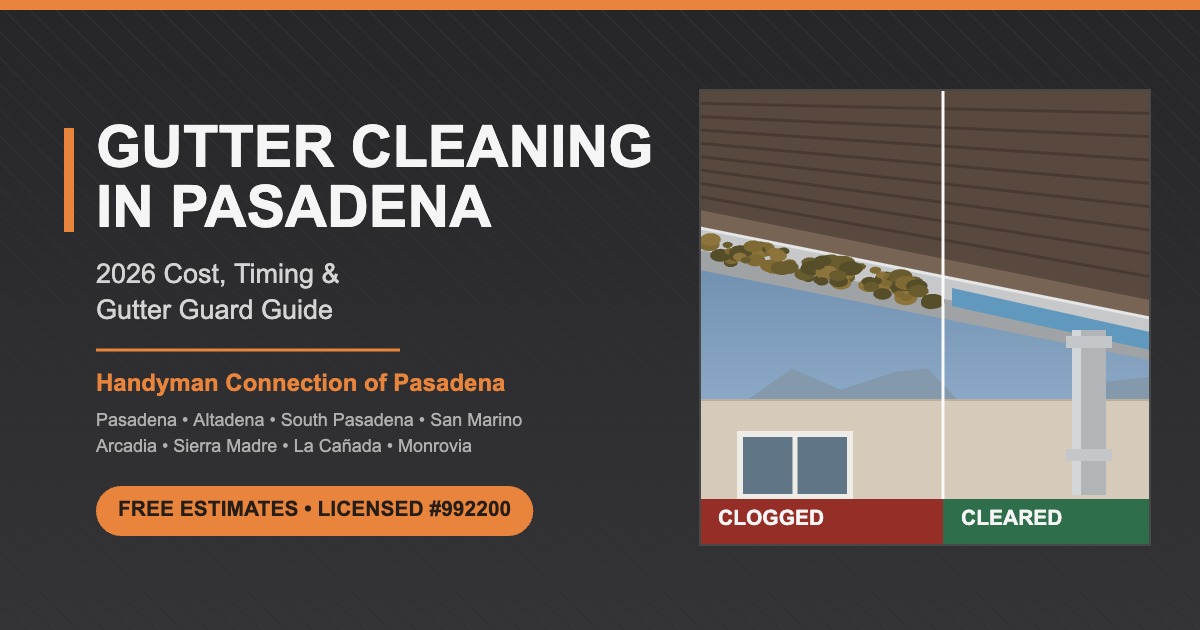
Ask any Pasadena homeowner when they last thought about their rain gutters and you will usually get the same sheepish answer: not since the last big storm. It is an easy thing to forget. From late spring through the middle of August, the sky over the San Gabriel Valley stays stubbornly blue, the Arroyo Seco runs dry, and a clogged gutter causes exactly zero problems. Then the first real atmospheric river rolls in off the Pacific, dumps two inches of rain on the 210 Freeway corridor in six hours, and a gutter packed with a season’s worth of sycamore leaves and oak tassels becomes an expensive problem in about ninety seconds.
That is why gutter cleaning in Pasadena is a late-summer job, not a winter one. Right now — mid-to-late August — is the sweet spot. The debris from spring bloom has finished falling, the first rains are still six to ten weeks out, and every reputable crew in town still has open calendar slots. Wait until the first storm warning hits the news and you will be calling a very long list of very busy companies.
This guide answers the questions Pasadena homeowners actually ask us: what it costs, how often it needs doing, which months matter, whether gutter guards are worth the money, and what has changed now that the 2025 California Wildland-Urban Interface code is in force across the foothills. Everything below reflects 2026 pricing and 2026 code — no recycled numbers from three years ago.
There is a persistent myth that Southern California homes barely need gutters. Anyone who has watched water sheet off a roofline in Bungalow Heaven during a January downpour knows better. Pasadena’s problem is not the total rainfall — it is the shape of it. We get most of our annual rain in a handful of intense, concentrated storms. A gutter system that would coast through a gentle Midwest drizzle gets overwhelmed here in minutes.
Homes north of Washington Boulevard, up along the foothills toward Altadena and La Cañada Flintridge, sit under a canopy of California live oak, deodar cedar, eucalyptus, and sycamore. Live oaks are the worst offender because they drop leaves nearly year-round rather than in one tidy autumn dump, and their small, leathery leaves knit together into a mat that water simply cannot pass through. Add the fine grit that Santa Ana winds carry down out of the canyons, and a foothill gutter can pack solid in a single season.
Pasadena’s housing stock is gloriously old. Craftsman bungalows around Bungalow Heaven, Spanish Colonial Revivals near Orange Grove Boulevard, and mid-century ranches out toward Temple City and Arcadia were built with deep eaves, exposed rafter tails, and wide fascia boards — all beautiful, and all extremely vulnerable to water that overflows instead of draining. When a gutter backs up on a Craftsman, the water does not politely run off the front edge. It runs backward, under the drip edge, into the rafter tails and the fascia. That is how a $250 cleaning turns into a $4,000 job — and it is exactly the failure pattern we describe in our guide to dry rot repair on Pasadena porches and rooflines.
We see this pattern every single winter, and it is almost always preventable. Overflowing gutters are also a leading cause of the wall-surface damage covered in our Pasadena stucco repair guide, because water running down a wall for four months does not stay on the surface.
Here are honest, current numbers for the Pasadena and greater Los Angeles market. Most companies price by linear foot, and a typical Pasadena home has somewhere between 120 and 220 linear feet of gutter.
What moves the price up in Pasadena specifically: two-story or three-story elevations, steep-pitched roofs common on older Tudor and Colonial Revival homes, heavy tree cover, tile roofing that requires walk-boards to avoid cracking, and downspouts that drain into underground piping and need flushing rather than a simple scoop-out.
A word of caution on the low end of the market: a $99 special almost always means a quick scoop of the visible debris and nothing else. A thorough job includes bagging and hauling debris, flushing every downspout to confirm flow, checking and resealing seams, tightening loose hangers, and giving you an honest report on what the system actually needs. That last part is what separates a service call from a sales call.
Not sure what shape your gutters are in? Our craftsmen will look at the whole system — gutters, downspouts, fascia, and drainage — and tell you what needs doing and what does not. Request a free estimate from Handyman Connection of Pasadena and get on the calendar before the fall rush.
The standard national advice — twice a year — is a decent starting point, but it is too blunt for our area. Pasadena splits neatly into three situations:
An easy self-check: after a rain, walk the perimeter of your house and look for the telltale signs. Vertical dirt streaks on the exterior of the gutter, plants or seedlings sprouting from the trough, water spilling over the front lip instead of running to the downspout, or a sagging section pulling away from the fascia all mean you are overdue. If you see rust stains on stucco below a seam, you are past overdue.
This is where local knowledge beats generic advice, because Pasadena’s calendar does not look like Ohio’s. Our rainy season generally runs from late October through early April, with the heaviest months typically December through March.
Gutters are the anchor of a broader fall checklist that also includes sealing exterior wood, clearing roof valleys, and checking drainage away from the foundation. If you are tackling the whole exterior this season, our Pasadena exterior painting guide and deck repair and sealing guide cover the two jobs most worth pairing with gutter work while the weather still cooperates.
One more Pasadena-specific note: if you are near the burn footprint from the 2025 Eaton Fire, hillsides above your property may be carrying loose ash, sediment, and mudflow risk for several seasons. Keeping gutters and downspouts fully clear is not just about your fascia in that scenario — it is about keeping water moving away from the foundation during exactly the storms most likely to cause debris flow.
This is the second-most common question we get, and the answer varies enormously depending on what you buy. Here is the 2026 landscape for gutter guard installation, priced per linear foot installed:
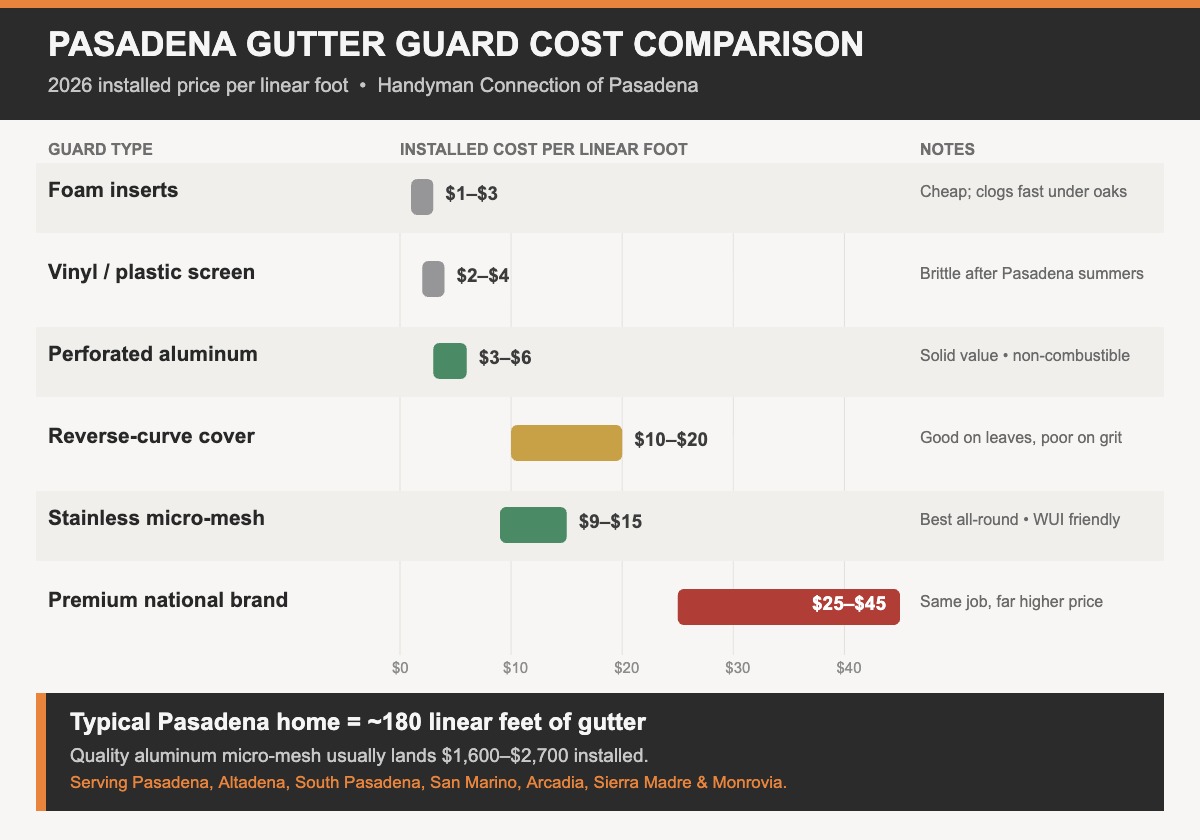
For a typical Pasadena home with 180 linear feet, quality aluminum micro-mesh gutter guard installation generally lands somewhere between $1,600 and $2,700 installed. If a salesperson quotes you $9,000 for a single-story bungalow, get a second opinion — and get it from a licensed local contractor rather than a national call center.
Honest answer: sometimes yes, sometimes no — and any contractor who says “always yes” is selling rather than advising.
Guards are usually worth it if: you have a two-story home where cleaning is expensive and genuinely risky; you are surrounded by live oaks or pines and cleaning three or four times a year; you are physically unable to maintain the system yourself; or you live in a designated Wildland-Urban Interface zone where non-combustible covers now do double duty as both debris control and ember protection.
Guards are often not worth it if: you have a single-story home on an open lot with modest tree cover. If a full cleaning costs you $200 twice a year and guards cost $2,000, the math takes five-plus years to break even — and guards do not eliminate maintenance, they reduce it. Micro-mesh in particular still needs the surface brushed or rinsed periodically, because fine grit and pollen build a film on the screen that sheds water right over the edge.
The most important variable is what is under the guard. Installing premium covers over a rusted, sagging, undersized gutter system is money poured into a bad foundation. If the trough itself is failing, the right move is rain gutter replacement first, guards second — or both at once, which is usually cheaper than doing them a year apart.
Want a straight answer for your specific house? Tell us your roof height, tree cover, and neighborhood, and we will tell you honestly whether guards pencil out. See the full range of home repair and maintenance services we offer in Pasadena, or call us to talk it through.
A good crew will tell you when a cleaning is not the fix. Here is how to tell the difference yourself.
Isolated leaks at a seam, a handful of loose or pulled hangers, one crushed section from a fallen branch, or a disconnected elbow are all straightforward repairs. So is most downspout repair — dented sections, separated joints, or a downspout that dumps water two feet from the foundation instead of carrying it away. Extending a downspout to discharge at least four to six feet from the house, or tying it into a proper drain line, is one of the cheapest and highest-value fixes in the entire home maintenance catalog, particularly on Pasadena’s older raised-foundation homes.
Widespread rust-through, sagging along multiple runs, seams that reopen after every repair, gutters that are simply undersized for the roof area, or a system old enough that the fascia behind it has begun to rot — those all point to rain gutter replacement. On a lot of Pasadena homes we also find gutters that were installed at the wrong pitch decades ago and have never actually drained properly. No amount of cleaning fixes a slope problem.
For a 180-foot system, seamless aluminum gutters typically run $1,100 to $2,500 installed, while copper on the same house can reach $5,000 to $9,000. If gutter work is part of a larger exterior project — new fascia, siding, or a facade refresh — it is worth coordinating with a full remodeling contractor. Local specialists like Pasadena Remodel and Pasadena Remodeler publish useful local cost guidance on larger exterior and whole-home projects that pairs well with the numbers above.
This is the single biggest shift in gutter thinking across the San Gabriel Valley, and a lot of homeowners have not caught up to it yet.
A gutter full of dry leaves sitting directly against a wood fascia and the edge of a roof deck is, functionally, kindling placed at the most vulnerable point of your house. Wind-driven embers travel well ahead of a fire front, and post-fire investigations across California consistently find roofline debris as an ignition point. Chapter 7A of the California Building Code requires that roof gutters in designated Wildland-Urban Interface areas be provided with a means to prevent the accumulation of leaves and debris, and the 2025 California WUI Code — in effect since January 1, 2026 — pushes further toward non-combustible gutters and covers. The UC ANR Fire Network’s research on gutters is a good plain-English primer if you want the underlying science.
Most of Altadena, Sierra Madre, and La Cañada Flintridge fall inside designated WUI zones, along with significant portions of northern Pasadena and the hillside edges near Eagle Rock and Highland Park. If you are rebuilding, remodeling, or replacing a roof in those areas, expect ember-resistant gutters to be part of the conversation with your plan checker.
What ember-resistant gutters means in practice: a non-combustible trough — aluminum, steel, or copper, never vinyl — paired with a non-combustible metal cover or micro-mesh screen that keeps debris out of the trough entirely. Verify with the City of Pasadena Planning and Community Development Department or your local building department rather than a product brochure, because acceptance varies by jurisdiction and specific product listings matter. But the general direction is unambiguous, and even outside a mandated zone, non-combustible ember-resistant gutters are simply good sense anywhere in the foothills.
Worth pairing with: clearing the roof valleys, keeping the first five feet around the foundation free of combustible mulch and vegetation, and screening attic and foundation vents with 1/8-inch metal mesh. Those four measures together do more for wildfire survivability than almost anything else a homeowner can do for the money — our full Pasadena wildfire home hardening checklist walks through each one in order of priority.
Before anyone climbs a ladder at your house, ask these. A good contractor will answer all of them without hesitation.
One more: ask whether the person quoting you actually works for the company doing the work. A surprising amount of gutter-guard selling in Los Angeles County is done by commissioned subcontract sales teams, which is a large part of why quotes for identical work can differ by a factor of four.
Handyman Connection of Pasadena works throughout the area from our shop on South Rosemead Boulevard, and the gutter conversation changes noticeably from neighborhood to neighborhood. Foothill homes in Altadena and La Cañada Flintridge carry the heaviest oak and pine debris load plus WUI considerations. The historic districts of South Pasadena and San Marino often call for copper or painted aluminum to match protected architecture. Sierra Madre combines steep lots, dense canopy, and fire-zone rules. Homes in Arcadia, Monrovia, and Temple City tend toward larger single-story footprints where straightforward seamless aluminum gutters are the practical answer. And in Eagle Rock and Highland Park, we work on a lot of hillside bungalows where the real issue is not the gutter at all — it is where the downspout puts the water on a sloping lot.
Whichever of those describes your home, the fix starts with an honest look at the whole system rather than a guess from the curb. You can see the full list of communities we serve if you are not sure whether you are inside our area.
Most Pasadena homes pay about $0.70 to $2.20 per linear foot on a single story and $1.50 to $3.75 per linear foot on a two story, which works out to roughly $175 to $225 for a standard single-family cleaning. Larger or steep-roof foothill homes in Altadena, Sierra Madre and La Cañada Flintridge commonly run $300 to $500.
Twice a year suits most Pasadena, South Pasadena, San Marino and Sierra Madre homes with mature trees. Homes directly under live oaks, eucalyptus or pines, common in Altadena and La Cañada Flintridge, need three to four cleanings a year. Newer homes on open lots in Arcadia, Monrovia and Temple City can often manage with one.
August through early October is the critical cleaning, done before the rainy season that runs from late October into early April. A second clearing in January or February keeps the back half of the season trouble-free. June and July are the best months for repairs or a full rain gutter replacement.
Installed prices per linear foot in 2026 run about $1 to $3 for foam inserts, $2 to $4 for vinyl screens, $3 to $6 for perforated aluminum, $9 to $15 for quality stainless micro-mesh, $10 to $20 for reverse-curve covers, and $25 to $45 for premium national brands. A typical 180-foot Pasadena home lands between $1,600 and $2,700 for quality aluminum micro-mesh.
Usually yes on two-story homes, properties under heavy oak or pine canopy, and homes in designated Wildland-Urban Interface zones where non-combustible covers also serve as ember protection. Often no on a single-story home with light tree cover, where the payback period exceeds five years. Guards reduce cleaning frequency rather than eliminating it.
Ask for the CSLB license number and verify it, confirm liability insurance and workers compensation, check whether the price includes flushing downspouts and hauling debris, ask how they protect tile or shake roofing, request before-and-after photos, ask what happens if you decline an upsell, and get the labor and materials warranty in writing.
Yes. Pasadena averages roughly 19 to 21 inches of rain a year but receives it in a small number of intense storms. Without gutters that water lands at the foundation, erodes landscaping, splashes soil onto stucco and siding, and contributes to crawlspace moisture and dry rot on raised-foundation homes.
On a single-story home with a stable ladder, a helper and no overhead power lines, many homeowners do. On a two-story home, a steep roof or a tile roof, hire it out. Falls from ladders are a leading cause of serious home-maintenance injuries, and a professional cleaning costs far less than the alternative.
A typical Pasadena single-story home takes one to two hours. Two-story homes with heavy debris and multiple downspouts can take three to four hours.
No, and any company that claims otherwise is overselling. Quality gutter guard installation typically reduces cleaning frequency from three or four times a year to once every year or two, and it turns a dirty scoop-out into a quick rinse.
Standard cleaning, downspout repair and like-for-like rain gutter replacement generally do not require a permit. Work tied to a roof replacement, a designated landmark or historic district property, or a Wildland-Urban Interface rebuild may trigger review by the City of Pasadena Planning and Community Development Department.
Late August through early October, before the first significant rain. Booking in this window means better availability, no emergency premium, and a system that is ready when the weather turns.
Gutters are the least glamorous system on your house and one of the most consequential. A few hundred dollars of maintenance in August protects fascia, rafter tails, stucco, foundations, and — in the foothills — a whole lot more than that. Whether you need a straightforward seasonal cleaning, targeted downspout repair, a full set of seamless aluminum gutters, or ember-resistant gutters that meet current WUI expectations, the work is far easier and far cheaper to do now than in December.
Handyman Connection of Pasadena is licensed (CSLB #992200), insured, and staffed by experienced local craftsmen who work on Pasadena’s older homes every day. Request your free, no-pressure estimate today, or learn more about Handyman Connection of Pasadena and the neighborhoods we serve. One call, and it is off your list before the rain arrives.

110 S Rosemead Blvd Suite G
Pasadena, CA 91107
License #992200

© Handyman Connection 2026 | Privacy Policy

 (626) 744-0402