We offer a wide range of services for that fresh look, or just maintenance or updates to keep your home functioning and safe. Regardless of the size of the job, we have a craftsman that can tackle it. We offer a wide range of services for that fresh look, or just maintenance or updates to keep your home functioning and safe. Regardless of the size of the job, we have a craftsman that can tackle it.
Home Improvement / July 6, 2026

When July settles over the San Gabriel Valley, Pasadena homeowners feel it everywhere — in the shimmering asphalt along the 210 Freeway, in the packed shade of Old Town Pasadena patios, and most of all in second-story bedrooms that refuse to cool down after sunset. The good news? Whole house fan installation in Pasadena is one of the smartest, most affordable upgrades you can make in 2026. By pulling cool evening air through your windows and flushing trapped heat out of your attic, a whole house fan can drop indoor temperatures by 10 degrees or more in minutes — for pennies compared to running the AC. In this guide, we cover how these systems work, real 2026 costs, and why they are perfectly suited to Pasadena’s dry, cool-evening climate.
Pasadena sits in a natural heat pocket. Afternoon temperatures near the Rose Bowl and along Orange Grove Boulevard regularly push into the 90s and beyond, and the region’s beloved older housing stock — especially the Craftsman bungalows of Bungalow Heaven — was built decades before central air conditioning existed. These homes have attics that soak up sun all day long, reaching 130 to 150 degrees by late afternoon. That superheated attic radiates warmth down into your living space all evening, which is why your bedroom still feels like an oven at 10 p.m. even after the outside air has cooled.
Here is the opportunity: Pasadena, Altadena, and the foothill communities of Sierra Madre and La Cañada Flintridge enjoy something most hot regions do not — cool, dry evenings. Once the sun drops behind the Arroyo Seco, outdoor temperatures often fall into the 60s. A whole house fan lets you harvest that free cool air instead of paying to manufacture it, which is why summer cooling strategies built around ventilation deliver such dramatic energy savings in our climate.
Homeowners from South Pasadena to Monrovia ask us this question constantly, and the distinction matters because the two systems solve different problems.
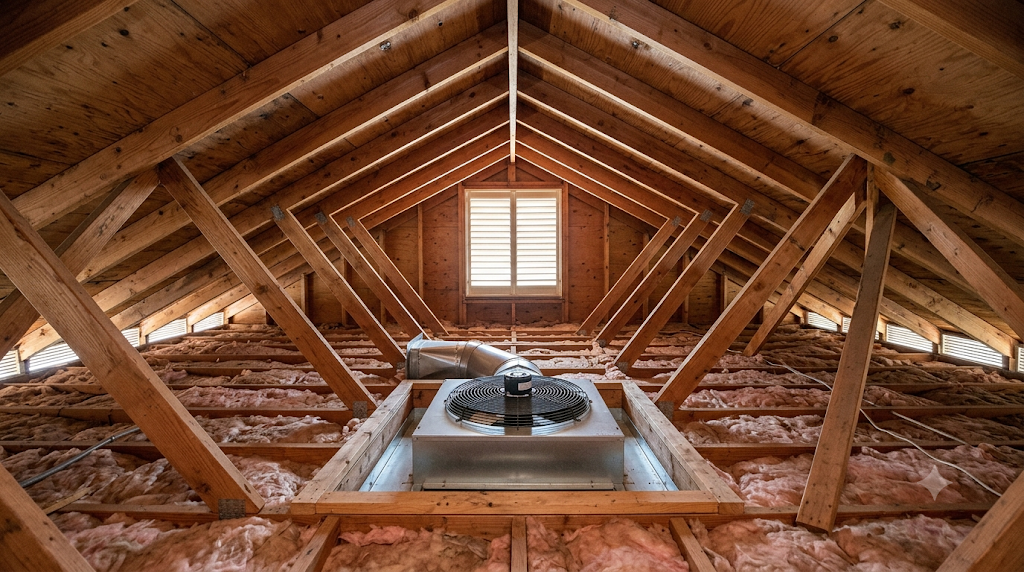
A whole house fan mounts in the ceiling of your top floor, usually in a central hallway. In the evening, you open a few windows and switch it on. The fan pulls fresh outdoor air through the windows, sweeps it through every room, and pushes hot indoor air up into the attic and out through the attic vents. The result is a complete air exchange for your entire home every few minutes — cooling the house and the attic at the same time. Modern systems are remarkably quiet, insulated against winter heat loss, and controllable from your phone.
An attic fan installation, by contrast, targets only the attic itself. Mounted on the roof or in a gable wall, it exhausts superheated attic air and replaces it with cooler outside air drawn through soffit vents. Your attic might drop from 150 degrees to 100 degrees, which reduces the heat radiating into your bedrooms and eases the load on your air conditioner. Solar-powered attic fans are especially popular across Arcadia, Temple City, and San Marino because they run all day at zero operating cost.
The best answer for many San Gabriel Valley homes is both: an attic fan installation to knock down daytime attic heat, plus a whole house fan to flush the entire home with cool air each evening. Together they can shrink your air conditioner’s workload to a few peak afternoon hours.
So what should you budget? In 2026, typical whole house fan cost runs between $900 and $2,400 installed, with most Pasadena-area homeowners landing around $1,500 to $1,800 for a quality ducted, insulated system professionally installed. A standard attic fan installation is more modest: roughly $300 to $1,500 complete, with mid-range electric units averaging $700 to $900 and solar models somewhat more after equipment costs.
Several factors move the number: the size of your home (a 2,800-square-foot San Marino two-story needs more airflow than a 1,100-square-foot bungalow in Highland Park), whether your electrical panel needs a new circuit, the amount of existing attic ventilation, and roof type. Tile roofs, common in Spanish-style homes near South Lake Avenue, take more care than composition shingle. An experienced craftsman will calculate the CFM (cubic feet per minute) your square footage requires and confirm your attic has enough net free vent area to exhaust it — an undersized vent path is the single most common DIY mistake we correct.
Ready for a real number instead of a range? Request a free estimate from Handyman Connection of Pasadena and a licensed local craftsman will size the right system for your home.
This is where whole house fans shine. Running central air conditioning in a typical Pasadena home costs $80 to $200 per month in summer. Running a whole house fan for the same cooling window costs $3 to $24 per month — the motors use 70 to 90 percent less electricity than an AC compressor. Households that switch to fan-first cooling and reserve the AC for peak afternoons routinely cut summer cooling bills by 50 to 80 percent, which means the system often pays for itself in one to three summers.
The energy savings story gets better in 2026: with California utilities pushing time-of-use rates, shifting your cooling to off-peak evening hours is rewarded on every bill. Some local utilities also offer rebates on qualifying high-efficiency fans. And beyond dollars, there is comfort — nothing beats falling asleep in a bedroom filled with cool, fresh foothill air instead of recycled refrigerated air.
A whole house fan is only as good as the attic ventilation behind it. Every cubic foot of air the fan pushes into your attic must escape through ridge vents, gable vents, or soffit vents. During whole house fan installation in Pasadena homes, our craftsmen inspect and often add vent area — a step many older homes in Eagle Rock and Highland Park need, since their attics were vented for 1920s standards, not modern airflow.
While we are up there, it pays to check insulation levels and seal obvious air leaks. Balanced attic ventilation plus adequate insulation keeps summer heat out and winter warmth in, multiplying your energy savings year-round. If your project uncovers bigger issues — sagging framing, aging ductwork, or a remodel-worthy layout problem — our sister team at Pasadena Remodeler handles full-scale renovation planning, and you can explore recent local projects at PasadenaRemodel.com.
Pasadena’s historic districts deserve special care. In Bungalow Heaven and along the grand blocks of Orange Grove Boulevard, ceilings may be plaster-and-lath, attic framing is often true-dimension old-growth lumber, and knob-and-tube wiring still lurks in some attics. A proper installation respects all of it: cutting the ceiling opening cleanly between joists, verifying the wiring can safely carry the new circuit, and choosing a grille that sits flush and unobtrusive in a period hallway. This is exactly the kind of work where an experienced, licensed craftsman earns their fee — and why neighbors across South Pasadena, San Marino, and Sierra Madre call us rather than risk a weekend DIY cut into a 100-year-old ceiling.
Not sure what your older home needs first? Browse our full list of handyman services in Pasadena — from electrical and carpentry to painting and drywall — and let one craftsman coordinate the whole job.
Handyman Connection of Pasadena installs whole house fans and attic fans throughout the area: Pasadena, Altadena, South Pasadena, Arcadia, San Marino, Sierra Madre, La Cañada Flintridge, Eagle Rock, Highland Park, Monrovia, and Temple City. Whether you are cooling a hillside home above the Rose Bowl, a mid-century ranch in Temple City, or a courtyard condo near South Lake Avenue, our licensed, insured craftsmen (CA License #992200) size, install, and warranty the work.
Most homeowners pay $900 to $2,400 installed, depending on home size, electrical work, and existing attic ventilation. A stand-alone attic fan installation typically runs $300 to $1,500. The average whole house fan cost for a typical Pasadena bungalow lands near $1,500 to $1,800.
Yes — they are close to ideal here. Whole house fans depend on evening air that is cooler than indoor air, and the San Gabriel Valley reliably cools into the 60s most summer nights. That is why fan-first summer cooling can cut AC use by 50 to 80 percent locally.
If you can pick only one, a whole house fan cools people and the structure, so it delivers more comfort per dollar. An attic fan installation is the right first step when your main complaint is a hot upstairs during the day, or when your budget is under $1,000. Many homes benefit most from both.
A straightforward installation is usually complete in half a day. Older homes needing added vent area or a new electrical circuit may take a full day. Either way, you sleep cooler that same night — with meaningful energy savings on your very next bill.
The first triple-digit stretch of 2026 is coming, and installation calendars across Pasadena fill fast once it arrives. Get ahead of it. Request your free estimate from Handyman Connection of Pasadena today, or call (626) 744-0402 to talk through whole house fan cost, sizing, and scheduling with a local expert. One visit, one licensed craftsman, and your home is ready for every warm evening from the Rose Bowl fireworks to the last barbecue of October.

110 S Rosemead Blvd Suite G
Pasadena, CA 91107
License #992200

© Handyman Connection 2026 | Privacy Policy

 (626) 744-0402