We offer a wide range of services for that fresh look, or just maintenance or updates to keep your home functioning and safe. Regardless of the size of the job, we have a craftsman that can tackle it. We offer a wide range of services for that fresh look, or just maintenance or updates to keep your home functioning and safe. Regardless of the size of the job, we have a craftsman that can tackle it.

Electrical / October 19, 2026
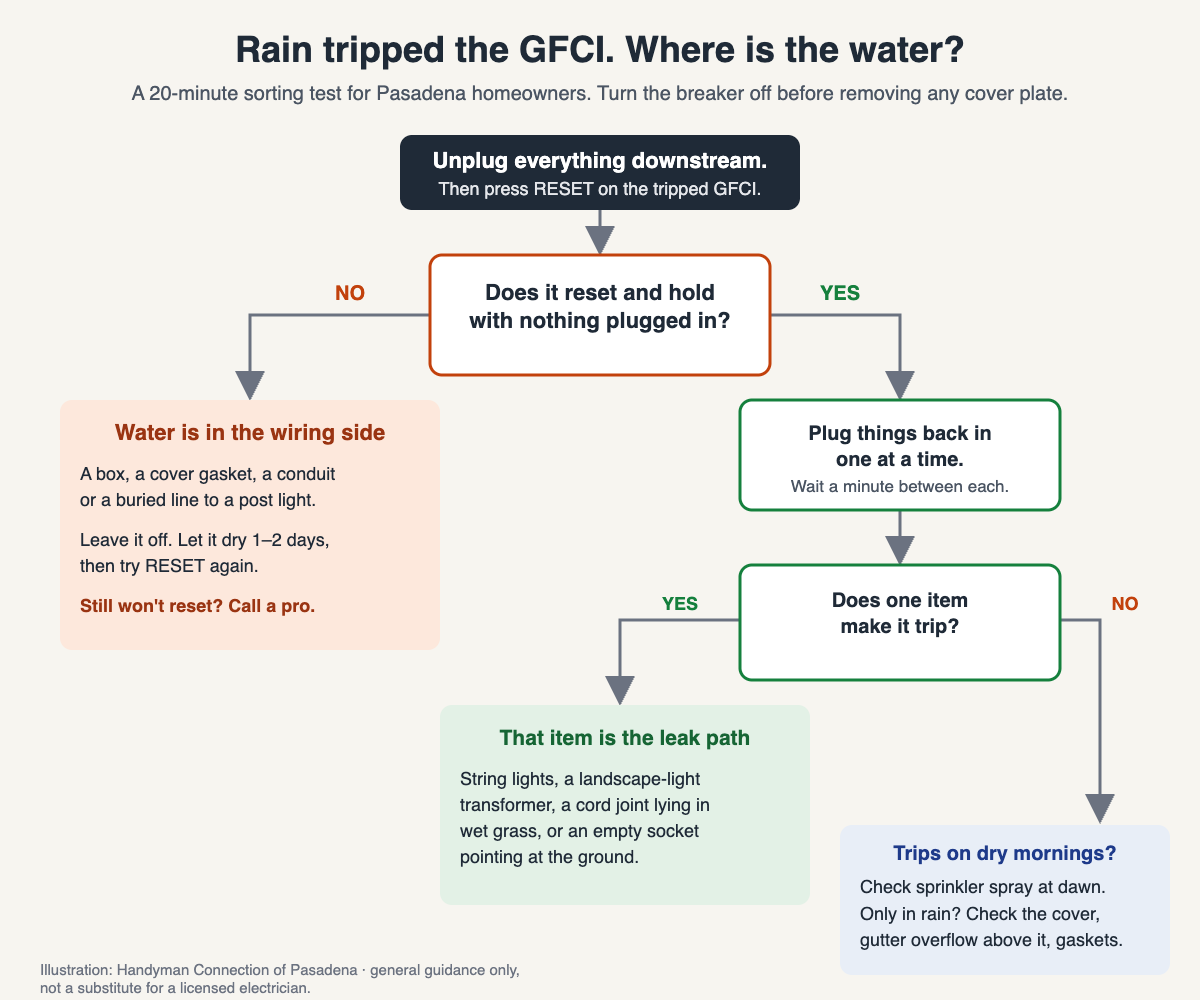
Every fall the same thing happens in Pasadena. The first real storm rolls in after a dry season that usually runs from May into October, and the next morning the patio lights are dead, the fountain pump is quiet, and a bathroom outlet across the house won’t power a hair dryer. Somewhere, a GFCI has tripped.
The instinct is to treat the GFCI as the problem. It almost never is. A ground fault circuit interrupter shuts the power off when it detects a tiny leak of current, roughly 5 milliamps, going somewhere it shouldn’t. Rain gives that current a path. So the useful question is not “why is my GFCI acting up?” but “where is the water getting in?” This article answers that one question, in the order we would check it.
The outlet that stopped working is often not the one with the buttons. One GFCI protects every outlet wired after it, and in a lot of Pasadena houses the outdoor outlets were added years after the house was built and tied into whatever circuit was handy. In 1950s ranch houses like the ones we wrote about in our Hastings Ranch piece, the controlling GFCI is commonly in the garage, a bathroom, or behind something in the laundry area. Check the panel too: some circuits are protected by a GFCI breaker instead of an outlet, and it will sit in a middle “tripped” position rather than fully off.
If the button pops back out the moment you press reset, don’t keep pressing it. That is the device telling you the fault is still there.
The old spring-loaded flip covers only keep rain out when nothing is plugged in. Plug in a timer or a cord and the lid sits propped open, and water runs straight down the cord into the face of the outlet. The electrical code (NEC section 406.9, which California adopts) now calls for wet-location outlets to have an “extra-duty” cover that stays weatherproof while a cord is plugged in, the deep bubble style, plus a weather-resistant (WR) receptacle. If your outdoor outlet still has a flat flip lid and you leave things plugged in through the winter, this is our first suspect, and it is a cheap fix.
Here is the Pasadena-specific clue: if the GFCI also trips on clear days, usually discovered in the morning, look at your irrigation timer. Many yards here water before dawn, and a spray head that drifted or a shrub that grew in can put water on a wall outlet every single cycle. Homeowners blame the first storm because that’s when they start paying attention. Adjust the head or move the outlet’s exposure before you replace anything.
An outlet under the drip line of an overflowing gutter gets a steady stream instead of a few drops. If the outlet is on a stucco wall below a corner where the gutter spills, cleaning and checking the gutters may be the whole fix. Water can also enter the box from behind through a cracked stucco surround or a conduit that slopes toward the box. One caution: don’t respond by caulking every edge shut. As we explained in our pre-rain caulking myths article, sealing the wrong gap traps water rather than stopping it. A properly gasketed cover is the right barrier; cracked stucco around the box is a separate repair.
If the test above pointed to a device, the usual causes are holiday or patio string lights with an empty end socket lying in wet grass, a cord-to-cord connection sitting in a puddle, or an aging landscape-lighting transformer. Lift connections off the ground, cap unused sockets, and replace any cord with cracked insulation. If you are planning holiday lights, this pairs well with the outlet test in our week-before-guests repair list.
Older properties often have direct-buried wiring running to a lamppost or a garden fixture. After a soaking rain the ground stays wet for days, and damaged insulation underground leaks current the whole time. The tell is a GFCI that trips during rain and keeps tripping for a day or two afterward, even with nothing plugged in. This is not a do-it-yourself repair.
What about lightning? Surges can trip a GFCI, but thunderstorms are uncommon here. If yours trips in an ordinary drizzle, lightning is not your answer.
When the GFCI won’t hold even with everything unplugged, water is likely sitting in a box, a cover, or the wiring itself. Leave it off and let things dry for a day or two, then try again. If it still won’t reset, the problem is in the wiring or the GFCI has failed, and it’s time to have someone open it up.
Replacing a flat cover with an in-use cover, swapping in a new weather-resistant GFCI, or relocating a cord-and-timer setup is routine work for our electrical service team, and it is a sensible item to bundle with other fall maintenance. If you want to understand what an outlet replacement involves, this walkthrough covers the basics. Outlets on a deck or under a patio cover still count as damp or wet locations and need the same treatment.
A damaged buried line, a new circuit, or a fault you can’t isolate is work for a licensed electrician, and new circuits generally need a permit through the City of Pasadena’s Permit Center. Our guide to the signs you need an electrical contractor explains where that line falls. Whoever you hire, you can confirm their license on the CSLB license lookup.
If the first storm knocked out your outdoor power and the test above didn’t find it, request a free estimate or call us at (626) 744-0402. Handyman Connection of Pasadena, 110 S Rosemead Blvd, Pasadena, CA 91107, CSLB License #992200.
Usually neither. A GFCI that trips when water reaches an outlet, cord or buried line is working correctly. Unplug everything and reset it: if it holds, the fault is in something plugged in; if it will not hold, water is in a box, cover or the wiring, or the device has failed.
The old one may have stopped protecting you. GFCIs can fail in a way that still passes power but no longer trips. Units made after mid-2015 are required to self-test. A new GFCI that trips in rain is pointing you to a real leak path, such as a flat cover with a cord plugged in.
Moisture is probably still in the outlet box, cover or a buried line, so the fault is still present. Unplug everything, leave it off for a day or two to dry, and try again. If it still will not reset, have the circuit checked.
Yes, a nearby strike or surge can trip one, but thunderstorms are uncommon in Pasadena. If your GFCI trips during ordinary rain or on dry mornings when sprinklers run, look for water at an outlet, cord or buried line instead.

110 S Rosemead Blvd Suite G
Pasadena, CA 91107
License #992200

© Handyman Connection 2026 | Privacy Policy

 (626) 744-0402