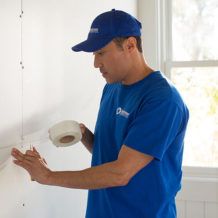
We are excited to announce that a long time Master Craftsman of our business is now the proud new owner; please join us in congratulating Earl Swader as the new owner of Handyman Connection of Blue Ash. Earl has previous business ownership already under his belt and is looking forward to continuing to serve the Blue Ash community as the proud owner.

Home Maintenance / September 18, 2026

Most property owners first encounter a building defect as a cosmetic event: a crack in the plaster, a stain on the ceiling, or a patch of damp that appears to need redecorating. From the surface, these problems can look local and straightforward, especially when the surrounding room seems unchanged.
However, the visible defect may be the end of a cause located elsewhere in the building. Cracks in walls and ceilings can reflect changes beyond the finish, while dampness may follow a hidden route before becoming visible. The challenge is deciding whether the problem is limited to the damaged surface or is evidence of something still happening. How can a property owner tell which type of problem they are facing before spending money?
A defect is generally safe to repair when its cause is known, occurred once, and is no longer active. A tile cracked by an impact or sealant that has reached the end of its useful life fits that pattern. These are common building repairs because the problem and the required work can be clearly defined.
The decision changes when the cause remains unknown, the building fabric is still moving, or an earlier repair has already failed. Covering active water ingress, moisture penetration, or structural movement buys silence rather than a lasting fix. The crack opens again, damp bleeds through the new paint, and remedial building work then includes removing and making good the first repair.
Therefore, the practical test is not how dramatic the damage looks. It is whether the property owner can name what caused it and establish that the cause has stopped.
A defect’s appearance rarely tells the whole story. Instead, its pattern, location, and change over time provide a better basis for deciding whether cracks in walls and ceilings belong to the finish or reflect structural movement. Even a narrow crack deserves closer attention when it sits in a significant location or continues to develop.
Fine plaster cracks caused by drying or seasonal movement tend to remain narrow and confined to the finish. Cracks that widen, taper, or continue through brickwork and mortar joints behave differently. Stair-step masonry cracks, horizontal foundation cracks, and cracks crossing corners or running around window and door heads can indicate movement caused by loading or ground conditions, including subsidence.
Location often matters more than width. A crack over an opening, on a load-bearing wall, or at the junction between an extension and the original structure carries a different meaning from the same mark on a lightweight partition. These patterns are among the more useful signs of foundation trouble.
Progression remains the strongest signal. Dated photographs and measurements taken against fixed pencil marks reveal whether a crack is stable or changing.
Similarly, dampness returning to the same place after redecoration points to an ongoing water path, not defective paint. Fresh coatings can temporarily conceal staining while water ingress continues through failed pointing, roof junctions, pipework, or gaps around openings.
The surrounding evidence helps distinguish moisture penetration from condensation. Tide marks, salt deposits, blistered paint, and localised staining suggest water moving through the building fabric. A musty smell in a consistently warm room also weakens the case for surface condensation, particularly when the damp appears after rainfall or follows a defined route down a wall.
A defect that returns after competent work provides useful diagnostic information. The repair addressed what was visible, but the process causing it remains active. Another identical repair will usually produce the same result.
Repeat leaks at one junction, re-cracking along the same line, and damp returning within a season all meet this test. Doors and windows that need easing again after adjustment can also reveal structural movement elsewhere. The sticking component may simply be where a changing opening first becomes noticeable.
Clear reasons to escalate include cracks wider than a few millimetres, measurable changes over weeks, sloping or bouncing floors, and bowing or leaning walls. Water appearing at a level with no evident source above it also needs tracing. Any defect involving a load-carrying element requires assessment before remedial building work begins.
Certain material failures sit outside ordinary patch-and-repair work. RAAC, or Reinforced Autoclaved Aerated Concrete, requires its condition and support arrangement to be understood. Concrete cancer involves degradation around corroding reinforcement, while combustible cladding, such as ACP, raises questions about the wider wall system. Some defects need a structural engineer’s calculations, some need a surveyor’s inspection, and some need construction consultancy input to set a strategy before any work is specified.
Finally, a record turns recurrence into evidence. Dated photographs, fixed-reference measurements, and invoices for previous repairs provide insurers, warranty providers, shared-ownership committees, and future buyers with a clear timeline.
As the recurring defects above show, the choice of assessor shapes the answer. A contractor focuses on defining and completing work, while a surveyor or engineer first determines why the defect exists. Calling the wrong discipline too early can produce a technically neat repair to the wrong problem.
A builder is the right choice when the cause is established and the work can be clearly specified, such as replacing failed sealant after checking the adjoining surfaces. However, a contractor should not be expected to resolve an open question about movement, hidden moisture, or connected symptoms through repair pricing alone.
A chartered building surveyor examines the building as a whole. Under RICS guidance, a thorough building inspection identifies visible and potential defects, considers probable causes, and recommends further investigation when the evidence is incomplete. That scope suits damp, roofing, external-envelope, and multi-symptom cases.
A structural engineer deals with loading and stability. Structural movement, bowing walls, floor deflection, alterations to load-bearing walls, and questions requiring calculations belong with that discipline.
Investigation usually begins without damaging the building. Crack gauges record movement over weeks or months, while moisture-meter readings taken in several places and at different depths help map a damp pattern. Drainage checks, rainwater tracing, and controlled water tests can reproduce a leak and identify its route.
Intrusive work should follow once the initial evidence points toward a specific location or mechanism. Removing finishes, digging trial pits, or exposing reinforcement without that direction can create disruption while missing the source.
The useful output is not merely a defect label. It is a report linking the evidence to a probable cause, identifying further checks, and setting out the remedy in the correct sequence. A contractor can then price defined work rather than allowing for an unresolved diagnosis.
The dividing line is straightforward: when the cause can be named and has stopped, the defect can be repaired. When the cause remains uncertain, is still active, or has already defeated one repair, the reason should be established first.
That pause is not needless delay. Once repeated labour, replacement finishes, disrupted rooms, and deterioration hidden beneath cosmetic work are counted, investigation is rarely the expensive option. The lasting response to building defects starts by addressing the mechanism and then making good the resulting damage.

11115 Kenwood Rd.
Blue Ash, OH 45242

© Handyman Connection 2026 | Privacy Policy

 (513) 771-3950