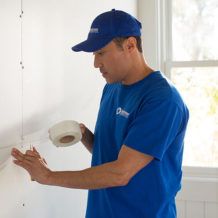
We are excited to announce that a long time Master Craftsman of our business is now the proud new owner; please join us in congratulating Earl Swader as the new owner of Handyman Connection of Blue Ash. Earl has previous business ownership already under his belt and is looking forward to continuing to serve the Blue Ash community as the proud owner.

Drywall / September 21, 2026

Open floor plans leave a lot of blank wall space, and homeowners are done filling it with a dozen mismatched frames. One bold piece, properly placed and properly hung, does more for a room than a cluttered gallery wall ever did. This guide walks through choosing the right scale for your space, prepping the wall correctly, and mounting heavy art so it stays level and secure for years, not just until the next time someone bumps the sofa.
Large-format “statement” art has become the dominant wall decor trend for 2026, with designers favoring a single oversized focal piece over the small, multi-frame gallery walls that dominated the last decade.
Picture a homeowner refreshing a long, blank wall above the living room sofa. Instead of hanging five frames at slightly different heights and hoping they read as intentional, many are now choosing a single large framed art piece as the room’s anchor point. One well-scaled piece does the job that used to take a whole arrangement, and it’s far more forgiving to hang correctly since there’s only one set of measurements to get right. Metal and wood framing are the two fastest-growing frame material choices for 2026.
Scale is where most large-art purchases go wrong. As a starting rule, your piece should span roughly two-thirds the width of the furniture beneath it, so a 90-inch sofa pairs well with art in the 55- to 65-inch range. Leave 6 to 8 inches between the top of the sofa and the bottom of the frame; any tighter and the piece looks jammed in, any looser and it floats awkwardly.
Ceiling height and sightlines matter too. In rooms with 9-foot or taller ceilings, art that would look oversized in a standard room often reads as just right. Walk the adjoining hallway or kitchen and check how the piece looks from a distance, not just standing directly in front of it.
This isn’t just an aesthetic call. The living room is the single room agents most often point to when discussing what matters for a sale, cited by 39% of agents in the National Association of Realtors’ 2025 Profile of Home Staging. The same report found that 83% of buyers’ agents say decor choices, including art, make it easier for buyers to picture themselves living in a home. A well-scaled statement piece does real work here, whether you’re settling in for years or getting ready to list. If you’re weighing decor decisions with resale in mind, our guide to staging tips that help a room show well covers more of what agents actually notice.
Before any hardware goes into the wall, figure out what you’re actually dealing with. Drywall, plaster, and masonry all hold weight differently, and guessing wrong is how frames end up on the floor. A stud finder takes the guesswork out of it in about thirty seconds, and hitting a stud is always the strongest option when one lines up with your placement.
When a stud isn’t available exactly where you need it, the anchor has to match the load. Plastic expansion anchors handle roughly 10 pounds, self-drilling toggle anchors handle 50 pounds or more, and a proper stud mount can carry 100 pounds or beyond. This isn’t a minor DIY nicety; the U.S. Consumer Product Safety Commission’s Anchor It! campaign marked its tenth anniversary in 2025, and the agency has tracked wall-anchoring failures as a real, ongoing home-safety issue for a decade, not a one-off warning. Consumer Reports’ guide on finding studs and anchoring furniture safely is a solid reference if you’re unsure what your wall can handle before you commit to a large piece.
Weigh your frame, or ask the retailer for a weight spec, before you buy hardware. A 40-pound framed canvas on a single plastic anchor is exactly the kind of mismatch that leads to a cracked wall or a piece crashing down months later.
Single-point hanging works fine for small, light frames. It doesn’t work for anything large enough to be a room’s focal point, since one hook lets the piece pivot and tilt every time someone brushes past it. Two-point mounting, using D-rings and wire spaced 30 to 50 centimeters apart, keeps the frame flat against the wall and stops that slow drift toward crooked.
For very heavy pieces, above roughly 100 pounds, a French cleat system spanning two or more studs distributes the weight far better than any single hook or wire ever could. It’s more setup work up front, but it’s the difference between a piece that stays put and one you’re re-leveling every few months.
Standard eye-level placement puts the center of the artwork around 57 inches from the floor, which lines up with most people’s eye line and is the benchmark museums use for hanging height. If you’re mounting something lighter, or working on a rental wall where drilling into studs isn’t an option, our piece on hanging items on walls without damaging drywall covers lower-impact methods that still hold securely.
A few mistakes show up again and again with oversized art, and all of them are avoidable:
None of these mistakes is expensive to prevent. They just take five extra minutes with a tape measure and a stud finder before you pick up the drill. Getting the placement right also pays off beyond the art itself; if you’re weighing bigger decor and layout changes at the same time, our rundown of home upgrades that boost your space before selling is worth a look.
Oversized statement art is one of the simplest ways to change how a room feels, and it doesn’t require a full renovation to pull off. The part that trips people up isn’t taste, it’s execution: choosing a size that actually fits the wall, finding the studs, and picking hardware rated for the real weight of the piece.
Measure twice, mount on real support, and level it before you step back. Do that, and the piece you hang this year is the one still hanging straight five years from now.

11115 Kenwood Rd.
Blue Ash, OH 45242

© Handyman Connection 2026 | Privacy Policy

 (513) 771-3950