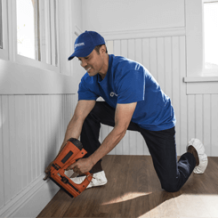
We are excited to announce that a long time Master Craftsman of our business is now the proud new owner; please join us in congratulating Earl Swader as the new owner of Handyman Connection of Blue Ash. Earl has previous business ownership already under his belt and is looking forward to continuing to serve the Blue Ash community as the proud owner.

Doors / April 30, 2026

A slamming door can rattle your nerves in seconds! One minute your home feels calm, and the next it sounds like someone is storming out. If you are tired of sudden bangs shaking the walls, the good news is that there are simple, practical fixes that actually work.
Below, you will find several clear solutions to stop your door from slamming.
Worn or loose hinges often allow a door to swing too freely. When air pressure shifts or someone gives it a light push, it slams shut with force. Tightening and adjusting the hinges is one of the quickest fixes.
Start by checking each hinge screw. Tighten anything loose, and replace stripped screws with longer ones for better grip. If the door still swings too fast, remove the hinge pin and bend it slightly before reinserting it, which creates friction and slows the door naturally.
Even minor hinge adjustments can noticeably reduce door movement. Small tweaks often make a big difference in everyday noise levels.
Sometimes the simplest fix is the most effective. A soft bumper absorbs impact and prevents the sharp crack of wood hitting the frame.
There are a few easy options to consider:
Each option takes only minutes to install. Felt pads are nearly invisible, while rubber or spring stops provide stronger resistance for heavier doors.
Impact-absorbing hardware can dramatically reduce noise without changing how your door functions. For renters or those who are after quick fixes, this approach keeps things simple and budget-friendly.
For a long-term, polished solution, concealed door hardware offers real control. Unlike surface-mounted closers, concealed systems hide within the door or frame while guiding it shut smoothly and quietly.
A properly installed closer regulates speed from start to finish. Instead of swinging freely and crashing into the frame, the door glides shut with steady resistance.
So, it is a good idea to use door closer arm systems. Reflect Window & Door, for instance, provides concealed door closers and arms that easily blend into modern interiors.
These systems are especially useful in offices, multi-family buildings, or high-traffic homes where durability matters.
Controlled resistance is the key advantage. Internal springs and hydraulic mechanisms manage the door’s speed through its entire swing.
Because the mechanism is hidden, the design stays clean and unobtrusive. Homeowners who prefer minimal hardware appreciate the low-profile look while still getting reliable performance.
Weatherstripping does more than seal drafts. It also cushions the space between the door and frame.
Self-adhesive foam or rubber strips create a softer landing when the door shuts. Instead of wood striking wood, the material absorbs the impact and reduces noise.
Many homeowners notice added benefits beyond quieter doors. For example, improved insulation can help stabilize room temperature and reduce energy loss.
A softer seal means fewer rattles, less wear over time, and better energy efficiency.
A misaligned latch plate can make a door snap into place too aggressively. When the latch catches abruptly, it amplifies the slamming sound.
Loosen the screws on the strike plate and shift it slightly to create a smoother catch. Filing the latch opening just a bit can also reduce resistance. Careful adjustments allow the latch to engage gently instead of snapping tight.
Small hardware tweaks often prevent bigger headaches later. A smoother latch means less force, less noise, and less long-term wear on your door frame.
Airflow plays a bigger role than most people realize. When HVAC systems kick on or windows are open, pressure differences can pull a door shut with surprising force.
Try keeping interior doors slightly ajar when heating or cooling systems run. Opening a nearby window by even just a crack can also reduce pressure imbalance. If slamming happens mostly during certain seasons, airflow is likely to be the culprit.
Air pressure changes inside modern, well-sealed homes can cause sudden door movement. Addressing airflow often solves the issue without any hardware at all.
Stopping a door from slamming does not require a major renovation. As we have seen, simple hinge adjustments, airflow fixes, and soft-impact accessories can all make a noticeable difference.
For homeowners or renters who want a clean, durable solution, installing concealed hardware and choosing to use door closer arm systems offers long-term control and protection.
Has this article been helpful? Of course, we hope so! If it has been, be sure to take a look at some of our other informative and relevant content.

11115 Kenwood Rd.
Blue Ash, OH 45242

© Handyman Connection 2026 | Privacy Policy

 (513) 771-3950