We offer a wide range of services for that fresh look, or just maintenance or updates to keep your home functioning and safe. Regardless of the size of the job, we have a craftsman that can tackle it. We offer a wide range of services for that fresh look, or just maintenance or updates to keep your home functioning and safe. Regardless of the size of the job, we have a craftsman that can tackle it.
Bathroom / October 26, 2026
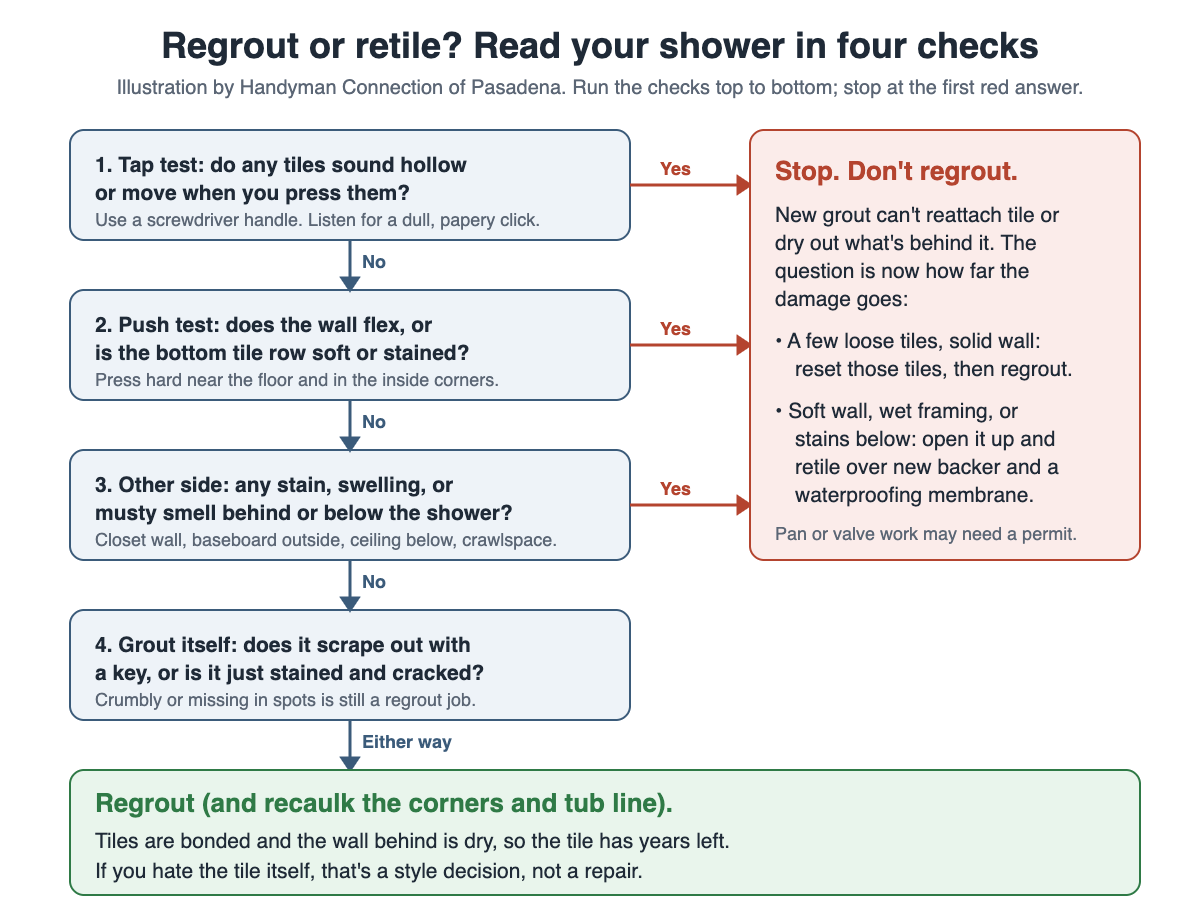
Most calls about a shower start with the grout: it’s dark, it’s cracked, it won’t come clean. The real question underneath is whether that grout is the problem, or just the part of the problem you can see. New grout on a sound wall buys you years. New grout on a wall that’s wet behind the tile is money spent putting a nicer face on a leak.
Here’s the check we’d walk a neighbor through before they pay anyone for either job. It takes about 15 minutes and a screwdriver, a house key and a flashlight.
Regrout when the tiles are tight and the wall behind them is dry. Retile when tiles are hollow or loose across more than a small patch, the wall flexes, or there’s any sign of water on the other side. Grout isn’t the waterproofing in a tiled shower. The membrane, backer board or mortar bed behind it is. So a regrout can make a shower look new without making it one bit drier.
A lot of older houses here, from the 1920s bungalows to the post-war ranches we wrote about in our Hastings Ranch post, have showers built the old way: tile set into a thick bed of mortar over wire lath. Those walls are heavy and stiff, and when they’re dry they last a very long time.
If a mortar-bed shower passes the checks above, our advice is to keep it. Reset any loose tiles, regrout, recaulk the corners. Tearing out a sound mud-set wall is loud, dusty, expensive work to replace something that may well outlast whatever goes in its place. If it’s the color you’re tired of, a contrasting grout changes the look more than people expect, and smaller bathroom updates like fixtures and lighting do the rest. If you truly can’t stand the tile, that’s a style decision and a remodeling conversation, not a repair.
The exception runs the other way. Plenty of showers redone in the 1980s and ’90s used moisture-resistant drywall, often called greenboard, behind the tile. California’s residential code no longer allows it as backing where it will be directly exposed to water, and when it gets wet it goes soft. If the push test finds give in a shower from that era, we’d skip the regrout entirely and put the money toward doing the wall properly.
Tiling is on the City of Pasadena’s list of work exempt from a building permit, grouped with painting, carpeting and “similar finish work.” A regrout falls squarely there. Replacing a shower pan, drain or valve is plumbing work and isn’t on that list, and opening walls to replace backing can raise the question too. The Pasadena Permit Center at City Hall, 100 N. Garfield Ave., can answer it for your address. If you’re in a landmark district, our Bungalow Heaven permits post covers the extra layer, though interior bathroom work usually isn’t what triggers it.
On price: national cost sites put a professional shower regrout at roughly $600 to $2,500 (Angi’s range, as reported by Bob Vila). That’s a market range, not our price, and we’re not going to throw out a retile number here, because it swings with the tile you pick and what turns up behind the wall.
What we can tell you is how we work: Handyman Connection of Pasadena has a $350 labor minimum per job. Regrouting a whole shower is generally a bigger job than that. Touching up a few grout lines is not, so if that’s all you need, it’s either a reasonable DIY weekend or something to bundle with other small fixes on one maintenance visit, like the punch list in our week-before-guests repair list.
Regrouting a sound shower is a fair DIY job if you’re patient. A few things decide whether it lasts:
Grout pens recolor grout; they don’t fix grout that’s crumbling. And there are good reasons grout work goes wrong for first-timers worth reading before you start.
If the push test or the other-side check worried you, call before you buy grout. We’ll check the wall, tell you which of the three outcomes above you’re in, and if it’s a repair, do it under CSLB license #992200 (you can verify any contractor’s license with the CSLB). If the wall does have to come open, it’s also the easiest moment to add blocking for grab bars, one of the aging-in-place changes that’s far cheaper done now than later. Our aging-in-place service covers the rest.
Call (626) 744-0402 or request a free estimate. Handyman Connection of Pasadena, 110 S Rosemead Blvd, Pasadena, CA 91107.
Yes. Cement grout is porous, and in a correctly built shower that’s expected: the waterproofing is behind the tile, and water that gets through drains down the membrane or pan. In a shower built without a proper membrane, or over greenboard, that same water ends up in the wall. That’s why the push test and the check on the other side of the wall matter more than how the grout looks.
You need to remove most of the joint depth so the new grout has something to lock into. Spreading new grout over a thin layer of old grout usually cracks and pops out within months.
Follow the cure time printed on the product. It varies by grout type, and it’s the most common reason a fresh regrout fails early.
No. Grout pens change the color of grout that’s still sound. They don’t replace grout that’s crumbling or missing, and they won’t stop water.
Regrouting is almost always cheaper, as long as the tiles are bonded and the wall is dry. If the wall behind the tile is wet or soft, regrouting isn’t a cheaper option at all, because it doesn’t solve the problem and you’ll pay for the retile later anyway.

110 S Rosemead Blvd Suite G
Pasadena, CA 91107
License #992200

© Handyman Connection 2026 | Privacy Policy

 (626) 744-0402