We offer a wide range of services for that fresh look, or just maintenance or updates to keep your home functioning and safe. Regardless of the size of the job, we have a craftsman that can tackle it. We offer a wide range of services for that fresh look, or just maintenance or updates to keep your home functioning and safe. Regardless of the size of the job, we have a craftsman that can tackle it.
Home Improvement / August 3, 2026
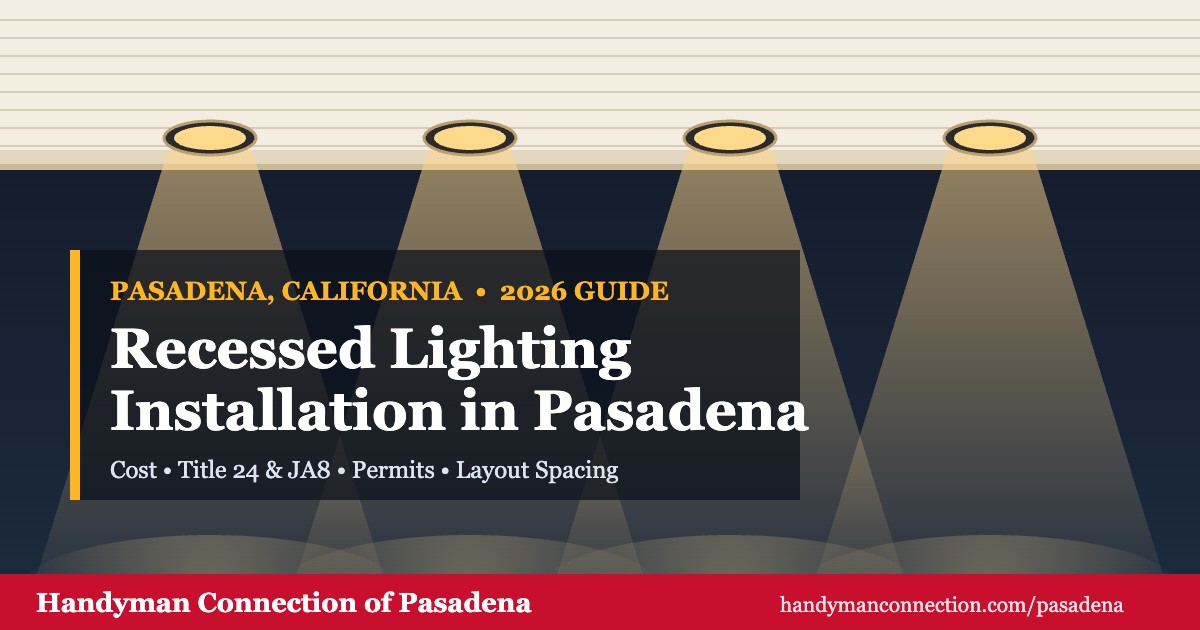
Walk into almost any original Craftsman bungalow in Bungalow Heaven and you will notice the same thing: the ceilings are beautiful, and the lighting is terrible. A single pendant in the middle of the room, a floor lamp in the corner, and shadows everywhere else. That is exactly why recessed lighting installation in Pasadena has become one of the most requested electrical upgrades in the San Gabriel Valley — it modernizes a room’s light without touching the plaster crown molding, the picture rail, or the built-ins that make these homes worth owning.
This guide answers the questions Pasadena homeowners actually ask before they call: what it costs in 2026, whether you need an electrician, whether you need a permit, how California’s energy code affects your fixture choice, and how many lights your room really needs. No fluff, no upsell — just the numbers and the code requirements, applied to the housing stock we actually work on from Altadena down to San Marino.
This is the first question every homeowner asks, and the honest answer is that recessed lighting cost is driven far more by what is above your ceiling than by the trim you pick out. Here is where prices land across Los Angeles County in 2026.
| Scenario | Typical Installed Price Per Light |
|---|---|
| Straight swap of an existing can (retrofit trim) | $90 – $160 |
| New light, open attic access above, drywall ceiling | $180 – $280 |
| New light, plaster-and-lath ceiling, tight access | $250 – $375 |
| New light routed around joists, ducts, or blocking | Add roughly $150 – $200 per fixture |
| New dedicated circuit and dimmer for the room | $350 – $900 one-time |
In practical terms, a typical six-light living room in a 1920s bungalow near Orange Grove Boulevard runs roughly $1,500 to $2,400 installed, including the fixtures, the dimmer, patching, and the permit. Industry cost data for the Los Angeles market puts the average whole-project range at about $1,501 to $2,339, which lines up closely with what we quote here in Pasadena. Kitchens with eight to ten lights, or homes that need a subpanel touched, run higher.
A useful rule of thumb: the recessed lighting cost per fixture drops meaningfully after the first three or four lights, because most of the setup, wire-pulling, and switch work is a one-time expense. Doing a whole floor at once is almost always cheaper per light than doing one room a year.
Want a real number for your ceiling instead of a range? Request a free, no-pressure estimate from Handyman Connection of Pasadena and we will walk your rooms, check what is above the ceiling, and price it honestly.
In California, yes — for anything beyond a like-for-like trim swap, you want a licensed electrician, and in most cases the law effectively requires one. If you are still deciding who to call, our guide to finding a qualified electrician in Pasadena covers what to ask before you hire. Here is the honest breakdown.
California’s Contractors State License Board requires a licensed contractor for work valued over $500 in combined labor and materials. Almost any multi-light job clears that threshold immediately. You can pull a permit as an owner-builder, but you take on the liability, the inspection, and the disclosure obligation when you sell.
Generally, yes. The City of Pasadena requires an electrical permit when you install recessed lights where none currently exist, and any new circuit requires a permit without exception. Replacing existing cans in place may not require one — that is a call worth making before you start. Pasadena’s Permit Center is at 175 N. Garfield Ave., and the Building & Safety line is (626) 744-4200.
Skipping the permit is a false economy. Unpermitted electrical work shows up in escrow, gets flagged by inspectors, and can void a homeowners insurance claim after a fire. Given that fire risk is not theoretical in the foothill communities above the 210 Freeway corridor, this is not a corner worth cutting — it belongs on the same list as the rest of your wildfire home hardening checklist. A reputable contractor pulls the permit as part of the job and meets the inspector so you do not have to.
We get asked this constantly, and we will give you the answer that is true rather than the answer that sells more jobs. If you have a modern drywall ceiling, a walkable attic, grounded Romex, and you are only extending an existing lighting circuit, a careful DIYer can do this. Thousands of people do.
Hire a professional if any of the following are true:
The failure mode we get called to fix is not usually a light that does not turn on. It is a ceiling with six holes cut in the wrong places, a cracked plaster field spreading across the room, and a homeowner who now needs a lighting job and a drywall job. That repair costs more than doing it right the first time.
This is the single biggest thing that separates a permitted, code-correct job from a job that fails inspection. California’s energy code, Title 24, sets mandatory requirements for residential lighting, and Title 24 lighting compliance is not optional on a permitted install.
For recessed downlights, the fixtures must meet the Joint Appendix 8 (JA8) standard. In plain English, a JA8-certified light must:
For permits pulled on or after January 1, 2026, your fixtures should carry the current marking — look for JA8-2025, or JA8-2025-E where elevated-temperature use applies — and appear in the California Energy Commission’s certified appliance database. If a contractor cannot tell you the JA8 marking on the product they are installing, that is a meaningful red flag.
One practical note for our climate: we usually steer Pasadena clients toward 2700K in living rooms and bedrooms and 3000K in kitchens and baths. The 4000K end of the JA8 range reads cold and clinical against the warm oak and fir trim that dominates Craftsman bungalow lighting throughout Bungalow Heaven, Madison Heights, and the older streets of South Pasadena and Eagle Rock. Many quality fixtures now ship with a selectable CCT switch, which lets you tune it on site.
Not sure whether your existing cans are JA8-compliant? Our craftsmen check the label as part of every walkthrough. See our full range of electrical services in Pasadena, or schedule your free estimate today.
Pasadena’s housing stock is older and more architecturally significant than almost anywhere else in the San Gabriel Valley, and that changes the job.
Plaster over wood lath does not behave like drywall. A standard bimetal hole saw dulls almost immediately and tears the surface; carbide-grit hole saws are the correct tool. Old hog’s-hair plaster crumbles as it is cut, so the hole has to be scored first and the lath located and cut cleanly, not torn. Done well, the trim ring covers the cut and you would never know. Done badly, you get spider cracks radiating three feet across a hundred-year-old ceiling.
Original knob-and-tube wiring was never designed to shed the heat of a recessed enclosure. The conductor insulation goes brittle and crumbles, and recessed or flush-mounted fixtures trap the heat that used to escape. When you change the fixture, the National Electrical Code requires you to install a proper box and bring the wiring method up to current standard. Where old conductors are involved, electricians favor plastic boxes over metal, because brittle knob-and-tube wire has a habit of shorting against a metal enclosure.
If we open your ceiling and find knob-and-tube, we will tell you before we go further. Sometimes the right answer is a partial rewire of that circuit rather than a lighting job on a foundation that will not hold.
If your home sits in a designated landmark district like Bungalow Heaven, review requirements generally focus on exterior alterations rather than interior lighting — but if your project touches soffits, porch ceilings, or anything visible from the street, confirm with Pasadena’s Design and Historic Preservation staff before work begins. It is a ten-minute phone call that prevents a very expensive misunderstanding.
For homeowners weighing a larger renovation alongside the lighting — reconfiguring a kitchen, opening a wall, or restoring period detail — it is worth reading up on how local specialists approach whole-home work. Resources such as Pasadena Remodel and Pasadena Remodeler cover the remodeling side of these older homes in useful depth, and lighting decisions are much cheaper to make before the drywall goes back up.
Overlighting is the most common mistake we see, and it is expensive twice — once at installation, once when the room feels like a retail store. Good recessed lighting layout follows a few reliable rules.
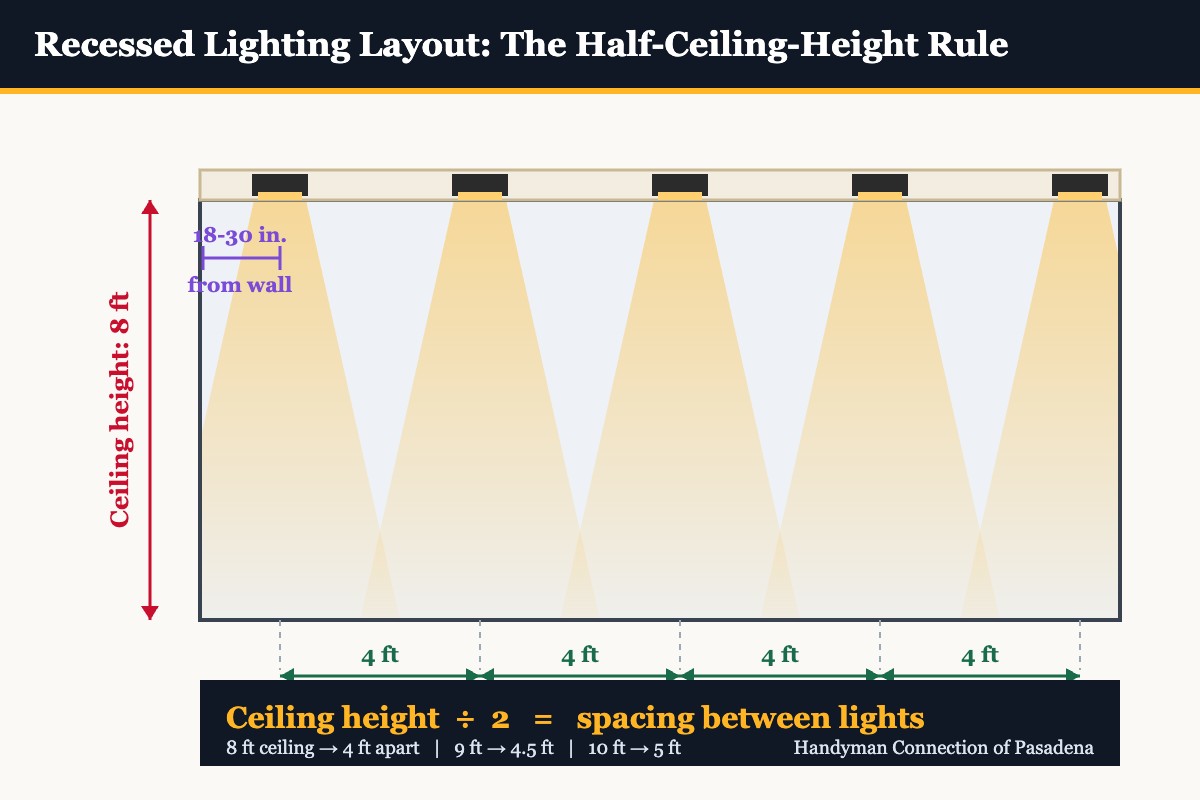
Divide your ceiling height by two, and that is your spacing between fixtures in feet:
Keep the first row 18 to 30 inches off the wall. Too close and you get hot spots washing up the wall; too far and the corners of the room go dark. Many manufacturers also publish a maximum spacing criterion — a multiplier between roughly 0.5 and 1.5 applied to ceiling height — which is worth checking for the specific fixture you buy.
A simple lumens-per-square-foot target keeps you honest:
A 14 × 18 living room with 9-foot ceilings — a very common footprint in Pasadena and San Marino — works out to roughly six lights on a 4.5-foot grid, plus dimmers. That is usually the whole answer. Adding four more does not make the room better; it makes it flatter.
A step-by-step method for planning a recessed lighting layout in a Pasadena home, from measuring ceiling height to specifying Title 24 compliant fixtures and pulling the electrical permit.
Measure floor to ceiling in the room you are lighting. This single number drives the entire layout. Most Pasadena bungalows run 8 to 9 feet; larger homes in San Marino and La Canada Flintridge often run 10 feet or more.
This is the core rule. An 8-foot ceiling means fixtures roughly 4 feet apart, a 9-foot ceiling means about 4.5 feet, and a 10-foot ceiling means about 5 feet. Check the manufacturer maximum spacing criterion for your specific fixture as well; it is usually a multiplier between 0.5 and 1.5 applied to ceiling height.
Too close and you get hot spots washing up the wall. Too far and the corners of the room fall dark. This offset also keeps the light off window coverings and artwork.
Target roughly 20 lumens per square foot for ambient light in living rooms and bedrooms, about 50 lumens per square foot over kitchen task surfaces, and 40 to 50 in bathrooms. A 14 by 18 foot living room with 9-foot ceilings works out to about six lights.
Use 4-inch fixtures in hallways, bathrooms and rooms under about 120 square feet, and 6-inch in larger living spaces. Choose 2700K for living rooms and bedrooms and 3000K for kitchens and baths so the light flatters original oak and fir trim.
If the ceiling is insulated, the housing must be rated for insulation contact and labeled airtight. Confirm the fixture carries the JA8-2025 marking so the installation passes California Title 24 inspection.
Put period pendants and sconces on their own dimmer rather than removing them. Recessed cans should carry the ambient light while the character fixtures carry the warmth.
Apply for a City of Pasadena electrical permit before work begins, then have the completed installation inspected. A licensed contractor handles both as part of the job.
The best-looking rooms in Pasadena’s older homes use recessed cans for ambient light and keep the character fixtures — the original dining room pendant, the sconces flanking the fireplace — for warmth. A good Craftsman bungalow lighting plan almost never means ripping out the period fixtures. It means putting them on their own dimmer and letting the cans do the invisible work.
A recessed can is a hole in your ceiling. If that hole is not sealed, conditioned air escapes into the attic year-round — which matters in Pasadena, where August attic temperatures regularly clear 130°F and your air conditioner is already working hard.
Energy codes require that recessed fixtures installed in an insulated ceiling be rated for insulation contact and labeled airtight. The specification to ask for is IC-AT: “IC” means the housing can safely touch insulation without a fire risk, and “AT” means it is sealed against air leakage, generally to a limit of 2.0 CFM at 75 Pascals under ASTM testing, with gasket or caulk between the housing and the ceiling.
If your home already has older non-IC cans, they are almost certainly leaking air and cannot be buried in insulation safely. A LED recessed lighting retrofit is often the cheapest fix available: modern airtight LED modules drop into most existing housings, cut wattage by 70 to 85 percent, and seal the ceiling penetration at the same time. For many homes in Altadena, La Cañada Flintridge, and Monrovia, a LED recessed lighting retrofit across an entire floor costs less than adding four new lights and pays back faster.
Handyman Connection of Pasadena handles recessed lighting installation in Pasadena and throughout the neighboring communities, and the housing stock shifts noticeably as you move across the map. We adjust the approach accordingly:
Every craftsman we send is background-checked, insured, and experienced with older Southern California construction — which, when your ceiling is a hundred years old, is the part that actually matters. Learn more about the full range of home repair and improvement services we offer, or start with Handyman Connection of Pasadena.
A six-light room with good attic access is typically a single day. Plaster ceilings, no attic access, or wiring upgrades push it to two or three days, plus a return visit for the City of Pasadena inspection and the final patch and paint.
Generally yes. The City of Pasadena requires an electrical permit when you install recessed lights where none currently exist, and any new circuit requires a permit without exception. Replacing existing cans in place may not require one. Pasadena’s Permit Center is at 175 N. Garfield Ave. and Building and Safety can be reached at (626) 744-4200.
Expect roughly $180 to $280 per light with open attic access and a drywall ceiling, and $250 to $375 per light through original plaster and lath. A typical six-light living room runs about $1,500 to $2,400 installed, including fixtures, dimmer, patching and permit.
Yes, using sloped-ceiling housings or adjustable gimbal trims that aim the beam straight down. This comes up constantly in La Canada Flintridge and the hillside homes above the Rose Bowl. Standard flat-ceiling cans installed in a sloped ceiling will throw light at the wall and look wrong.
Four-inch fixtures suit hallways, bathrooms and smaller bungalow rooms, and read as less intrusive on an original ceiling. Six-inch is the default for larger living spaces and kitchens. In rooms under about 120 square feet, four-inch almost always looks better.
JA8 is the California Title 24 standard that residential recessed downlights must meet. A compliant fixture has no screw-based socket, is airtight to under 2.0 CFM at 75 Pascals, delivers at least 45 lumens per watt, has a color rendering index of 90 or higher, dims to 10 percent without flicker and is rated for at least 15,000 hours. For permits pulled on or after January 1, 2026, look for the JA8-2025 marking.
It rarely appraises as a line item, but it consistently affects how a home shows. Well-lit rooms photograph better and feel larger, which matters when buyers walk in from bright Southern California sunlight into a dim interior. Pairing it with fresh paint produces the strongest effect.
Yes. JA8-certified LEDs run far cooler than the incandescent cans they replace and are rated for at least 15,000 hours. Combined with an IC-AT rated airtight housing, they are meaningfully safer than the older fixtures common in Pasadena’s mid-century homes.
Whether you are planning a full recessed lighting layout for a Craftsman in Bungalow Heaven, a straightforward LED recessed lighting retrofit in an Arcadia ranch, or you just want to know your real recessed lighting cost before you commit — we will give you a clear, permitted, code-compliant plan and an honest price.
Request your free estimate from Handyman Connection of Pasadena today — serving Pasadena, Altadena, South Pasadena, Arcadia, San Marino, Sierra Madre, La Cañada Flintridge, Eagle Rock, Highland Park, Monrovia, and Temple City.

110 S Rosemead Blvd Suite G
Pasadena, CA 91107
License #992200

© Handyman Connection 2026 | Privacy Policy

 (626) 744-0402