We offer a wide range of services for that fresh look, or just maintenance or updates to keep your home functioning and safe. Regardless of the size of the job, we have a craftsman that can tackle it. We offer a wide range of services for that fresh look, or just maintenance or updates to keep your home functioning and safe. Regardless of the size of the job, we have a craftsman that can tackle it.
Home Improvement / August 31, 2026
If you own one of the roughly 800 bungalows between Washington Boulevard and Orange Grove Boulevard, there is a rule that catches almost everyone at least once: the design review comes before the building permit, not after. Homeowners find this out in the worst possible order — after the windows have been ordered, after the deposit is down, after the crew is scheduled. This is a plain explanation of what needs review in the Bungalow Heaven Landmark District, what does not, and the sequence that keeps a project from stalling.
People use “Bungalow Heaven” loosely to mean everything from Lake Avenue to Hill Avenue. The Landmark District — the part with legal review requirements — is tighter than that. Its rough borders are Washington Boulevard on the north, Orange Grove Boulevard on the south, Mentor Avenue on the west, and North Chester Avenue on the east, with McDonald Park near the center. Pasadena designated it in November 1989, making it the city’s first landmark district.
This matters practically. A house on Mentor may be inside; a house two blocks west toward Lake may not be. Before you assume either way, call Design & Historic Preservation at (626) 744-6646 and ask them to check your parcel. It takes one phone call, and it changes the entire shape of your project. If your home is older but sits outside a landmark district, the review burden is much lighter — though the realities of repairing an older Pasadena home still apply.
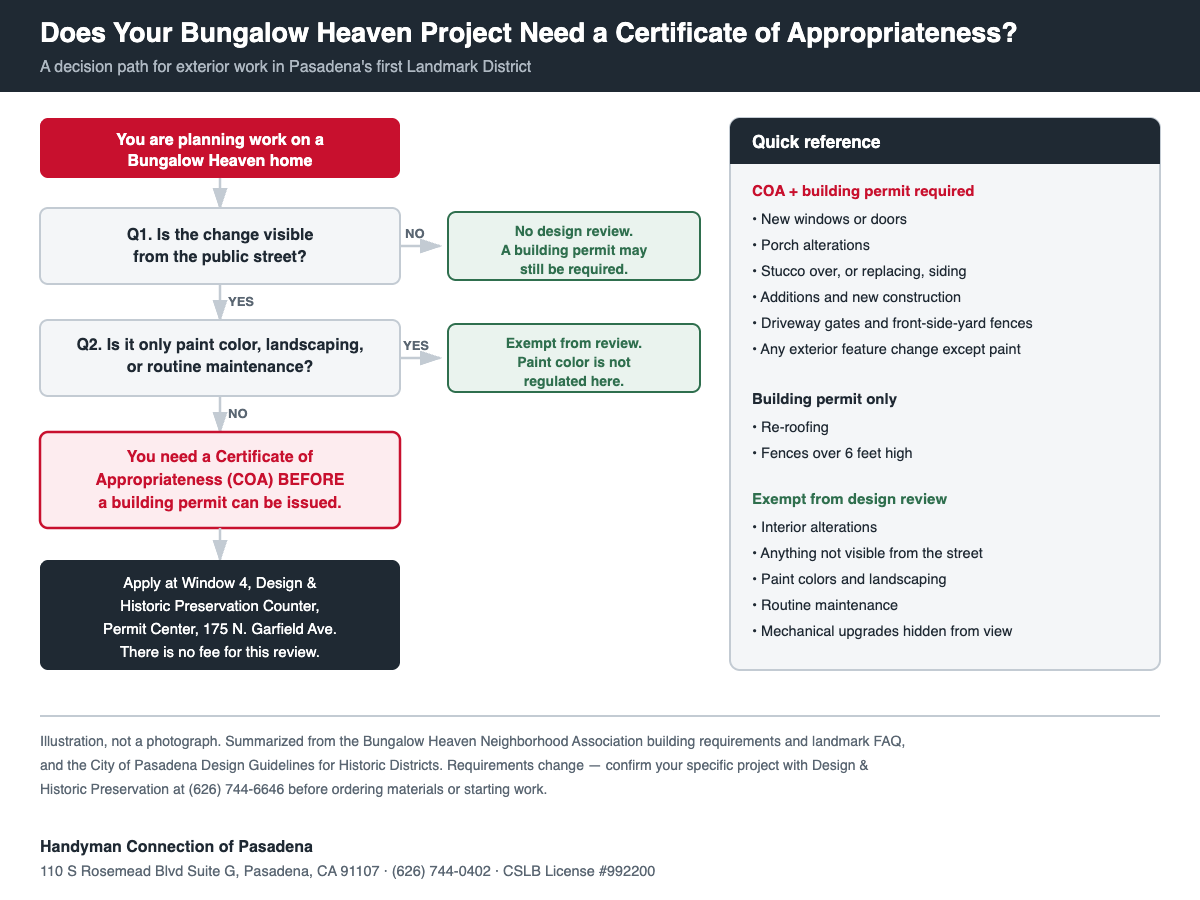
A Certificate of Appropriateness (COA) is a written confirmation that your proposed change complies with the Secretary of the Interior’s Standards, Pasadena’s Design Guidelines for Historic Districts, and the Bungalow Heaven Conservation Plan. The critical detail is procedural: a COA is required before a building permit can be issued. It is not a parallel track and it is not a formality you clean up later.
You apply at Window 4, the Design & Historic Preservation counter, in the Permit Center at 175 N. Garfield Avenue, with a completed application, drawings, photos, and material samples. Public counter hours are Monday through Thursday, 10:00 a.m. to 3:00 p.m., plus alternate Fridays (the second and fourth of each month) at the same hours. City staff review minor projects; the nine-member Historic Preservation Commission, which meets the first and third Mondays, reviews major ones. Decisions can be appealed.
This is one of the most common questions homeowners ask, and the answer surprises people: the City charges no fee for the Certificate of Appropriateness review itself. You still pay standard building permit and plan check fees for the underlying work, and those depend on valuation — but the historic review layer is free.
We think this is the single most underused free service in Pasadena. You can walk into Window 4 with a sketch and a photo before you have spent a dollar, and find out whether your idea will fly. Homeowners routinely skip this because they assume design review means expense and delay, then spend far more unwinding a decision the counter would have flagged in ten minutes.
The neighborhood association publishes a clear list. Work requiring both a COA and a building permit includes installing a new door or window, altering your porch, stuccoing over or replacing siding, building a driveway gate or front-side-yard fence, constructing an addition, and changing any exterior feature other than paint.
Some work needs a building permit but no design review — re-roofing, and fences over six feet high. And a meaningful category is exempt from design review entirely:
That exemption list does real work. Drywall repair, ceiling work, built-in shelving, most plumbing, and electrical upgrades that stay out of sight all proceed on the normal permit path. The review requirement is about the face your house shows the street, not about your right to a functioning home.
One trap worth naming: aging-in-place modifications are usually exempt as interior work, but a front-entry ramp or a handrail on the front porch is visible from the street and does trigger review. It is approvable — this is a common and sympathetic request — but it needs to go through Window 4 first.
This is an opinion, not a code citation. When a Bungalow Heaven homeowner asks us to swap original wood double-hung sash for vinyl, we say no more often than we say yes, for two reasons.
First, it will very likely not pass design review. Window replacement is explicitly on the reviewed list, and replacing original wood with vinyl in a landmark district is the textbook example of what the Design Guidelines exist to prevent. Second — and this is the part that has nothing to do with the City — original old-growth Douglas fir sash is better material than what you would replace it with. It is denser and more rot-resistant than modern softwood, and in most cases the actual problem is failed glazing putty, painted-shut sash, a broken sash cord, or localized rot at the sill. Those are repairable. We would rather rebuild the sash and add weatherstripping than replace a window that has already outlasted a century.
Where rot has genuinely won, that is a dry rot repair conversation, and it is worth checking the porch columns and sill plates at the same time — in bungalows of this era, water damage rarely stays in one place. If your issue is comfort rather than the sash itself, repairing screens is an exempt, permit-free improvement.
Unpermitted exterior work in a landmark district is a bad trade. If it is discovered — and neighbors here are attentive, which is a large part of why the district still looks the way it does — you can be ordered to stop work, required to apply for retroactive permits, charged permit and plan check fees at penalty rates, and, in the worst case, required to undo or redo the work to comply. Removing a newly installed window and restoring an original opening is an expensive way to learn the sequence.
There is a second exposure most homeowners do not anticipate. Unpermitted alterations surface during resale and appraisal, and in a district where buyers pay a premium for original character, “the porch was rebuilt without a COA” is a live negotiating point against you.
The Bungalow Heaven Neighborhood Association states this directly, and it is worth repeating: as the property owner, you are responsible for obtaining all required permits, including for work handled by a contractor. If your contractor skips the COA, the City’s problem is with your property, not with their business.
So verify it yourself. Ask to see the COA approval and the building permit before work begins, not after. A contractor who treats that request as an insult is telling you something useful.
“Do you work on historic homes?” is too easy a question — everyone says yes. Better questions:
On the last point: California requires a license for most work over $500 including materials and labor. Our license is CSLB #992200, and you should check it — the reasons to insist on a licensed contractor are sharper in a landmark district, where a mistake is not just a repair but a permanent subtraction from the house.
If you are new to the district and unsure where to start, our honest advice is unglamorous. Walk into Window 4 with photographs of your house and a list of everything you are thinking about doing in the next three years — not just the urgent item. Ask which items need a COA. The review is free, and you will leave with a sequence: the exempt work you can start immediately, and the reviewed work that needs lead time.
Then do the invisible work first. Stucco and siding questions, porch and deck structure, drainage, and rot repair are what actually determine whether the house survives another century. The visible decisions — fencing, gates, fence repair, and additions — benefit from being made slowly and with the Conservation Plan open. If your project is genuinely a restoration rather than a repair, our historic home restoration work is the better starting point.
In the Bungalow Heaven Landmark District, a bathroom remodel needs a building permit, but interior alterations are exempt from historic design review — so no Certificate of Appropriateness is normally required. The exception is if the project changes something visible from the street, such as adding or resizing an exterior window. Mechanical, plumbing and electrical upgrades are also exempt from design review as long as the work is not visible from the street.
You can be ordered to stop work, required to apply for retroactive permits, and charged permit and plan check fees at penalty rates. In serious cases the City can require the work to be undone or redone to comply. There is also a resale problem: unpermitted alterations surface during appraisal and inspection, and in a landmark district where buyers pay a premium for original character, that becomes a negotiating point against you.
The City of Pasadena charges no fee for the Certificate of Appropriateness review itself. You still pay standard building permit and plan check fees for the underlying construction, which vary with project valuation. Because the historic review is free, it is worth visiting Window 4 at the Permit Center with a sketch before you spend anything.
Ask questions that are hard to fake. Has the contractor personally submitted a Certificate of Appropriateness application at Window 4? Can they tell you what is in the Bungalow Heaven Conservation Plan? Would they repair an original window sash or immediately replace it? And verify the license number yourself on the CSLB website rather than accepting it on faith. California requires a license for most work over $500 in combined labor and materials.
The design review requirement is the trade-off most buyers weigh. It does add a step before exterior work, but it is also the reason the neighborhood has kept its character and its premium since 1989. Landmark designation does not affect the use or sale of your property, interior work is unrestricted, and paint colors are not regulated. If you want to make sweeping exterior changes, this is the wrong neighborhood; if you want the house to stay what it is, the rules are working in your favor.
Homes of this era were commonly built on shallow, unreinforced concrete or brick perimeter foundations with raised floors and cripple walls, and many are not bolted to the foundation. Typical findings are settlement cracking, deteriorated mortar, moisture and rot in the mudsill and floor framing from poor drainage, and unbraced cripple walls. Structural foundation work requires a licensed structural professional; foundation repair falls outside handyman scope. Related rot in sill plates, porch columns and framing is repairable and is a good place to start an assessment.
We are not the City and we cannot approve anything. What we can do is tell you honestly whether the work you are considering is exempt, reviewable, or a bad idea — before you order materials.
Handyman Connection of Pasadena
110 S Rosemead Blvd Suite G, Pasadena, CA 91107
(626) 744-0402
CSLB License #992200
Request a free estimate and tell us your cross streets — we will tell you whether you are inside the district before we talk about the work itself.

110 S Rosemead Blvd Suite G
Pasadena, CA 91107
License #992200

© Handyman Connection 2026 | Privacy Policy

 (626) 744-0402