We offer a wide range of services for that fresh look, or just maintenance or updates to keep your home functioning and safe. Regardless of the size of the job, we have a craftsman that can tackle it. We offer a wide range of services for that fresh look, or just maintenance or updates to keep your home functioning and safe. Regardless of the size of the job, we have a craftsman that can tackle it.

Home Improvement / August 10, 2026
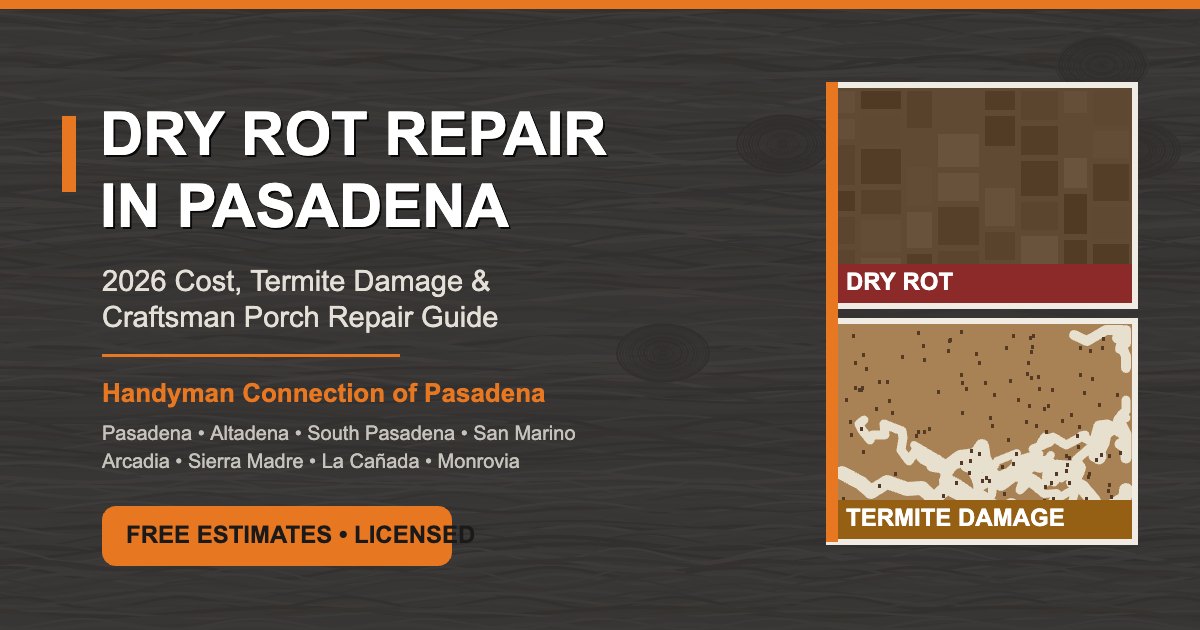
Every August, our craftsmen get the same phone call from homeowners across Pasadena: “I leaned on my porch railing and my thumb went straight through it.” Late summer is when wood damage finally announces itself in the San Gabriel Valley — and it is also the exact moment drywood termites begin swarming across Southern California. If you own a Craftsman bungalow near Bungalow Heaven, a Spanish Revival off Orange Grove Boulevard, or a mid-century ranch in the flats near the 210 Freeway corridor, this guide will tell you what you are actually looking at, what it costs to fix in 2026, and when a repair turns into something bigger.
We built this article around the three questions Pasadena homeowners ask us most: What is this damage? What will it cost? and Can it be repaired, or does it have to be replaced? Here are honest answers — including the parts most contractors would rather not put in writing.
Pasadena’s climate creates a very specific damage pattern. Our winter rains soak untreated wood, our long dry summers bake it, and the daily temperature swing between the Arroyo Seco canyon and the flatlands drives moisture in and out of end grain year after year. That cycle opens hairline checks in paint, water gets behind the finish, and fungus does the rest.
At the same time, drywood termite swarms in Southern California typically run from August through October, peaking in September and October. That is why August and September calls spike. The UC Statewide IPM Program pest notes on drywood termites are the best free technical reference if you want to confirm what you are seeing. Homeowners in Altadena and Sierra Madre see the swarmers, start poking at their trim, and discover the damage was there long before the insects showed up.
The good news: catching it now, before the first serious rain arrives in November, is dramatically cheaper than catching it in February. Exterior wood repair done in dry weather cures properly, primes properly, and seals properly. The same repair attempted during a storm cycle often has to be redone.
This is the single most common question we get, and getting it wrong costs real money. Understanding dry rot vs termite damage determines whether you need a carpenter, a pest control operator, or both. Here is how to tell them apart without any special tools.
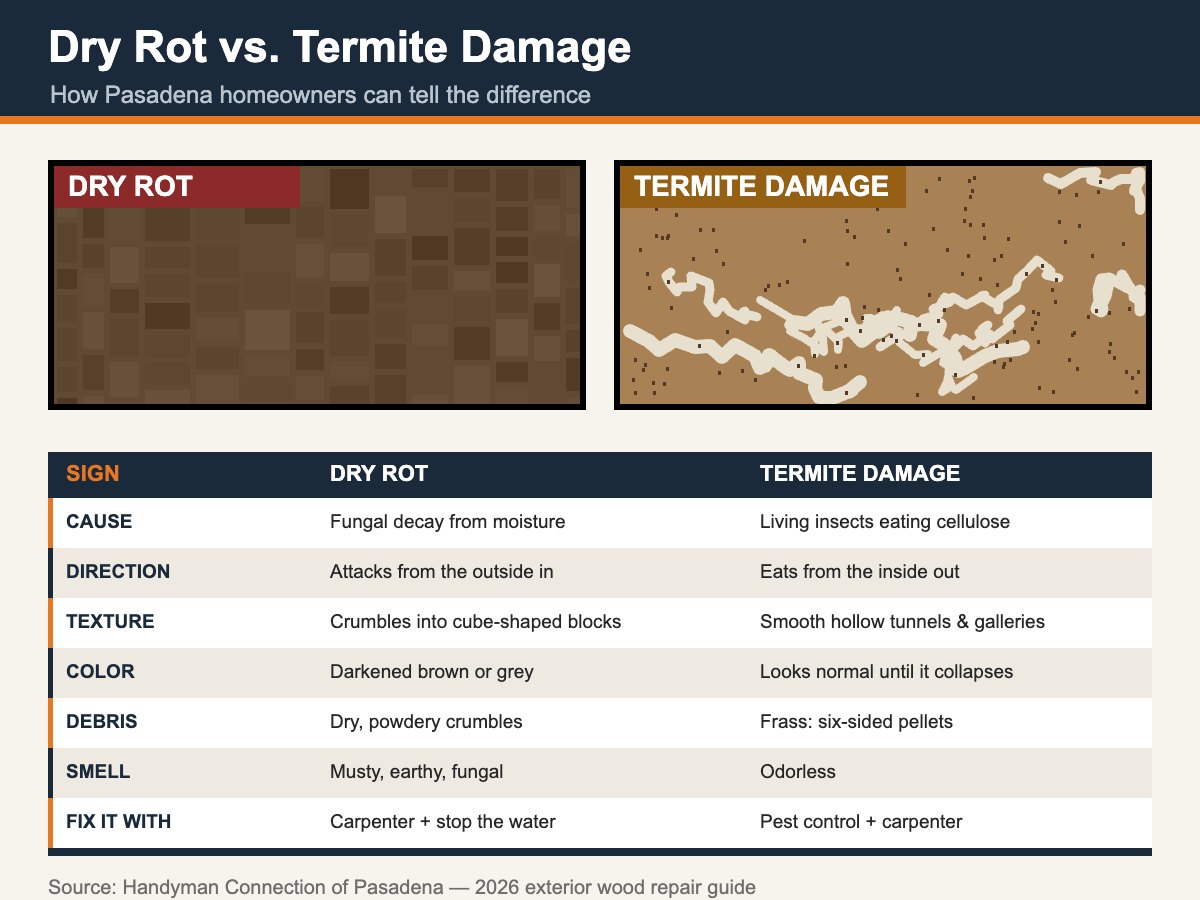
Despite the name, dry rot is a moisture problem. It is a fungal decay that needs water to get started, and it attacks wood from the outside in. Look for:
Termites eat wood from the inside out, which is why the surface can look perfectly fine right up until it collapses. Look for:
Time needed:
A five-minute test any Pasadena homeowner can perform to tell whether wood damage is fungal dry rot or active termite activity before calling a professional.
Look for bubbling or flaking paint, dark staining, or a soft spot. The most common locations on Pasadena homes are porch column bases, window sill corners, fascia boards behind gutters, and the bottom of stair stringers.
Tap firmly with the screwdriver handle. A hollow sound suggests termite galleries have eaten the interior while leaving the painted surface intact.
Press the blade into the wood at a 45-degree angle using light pressure. If it sinks in more than about a quarter inch, the wood is compromised.
Crumbly, cube-shaped fragments indicate dry rot. Clean, smooth tunnels with tiny six-sided pellets indicate termites. Soft, stringy, spongy fibers usually indicate wet rot from an active leak.
Dry rot needs a carpenter plus a permanent fix for the moisture source. Termites need a licensed pest control operator first, then a carpenter for the structural repair. If you find both signatures, you need both trades.
An honest warning: the two problems frequently occur together. Termites are attracted to wood that is already damp and softened by fungus. On many of the older homes we inspect in South Pasadena, San Marino, and Highland Park, we find both. If you see both signatures, you need a licensed pest control operator to handle the infestation and a carpenter to handle the structure. We do the carpentry, and we will tell you plainly when you also need pest control.
The honest answer is that wood rot repair cost depends almost entirely on whether the damage is cosmetic or structural — and you cannot always tell until the paint comes off. That said, here are realistic 2026 ranges for the San Gabriel Valley. Local labor rates run above the national average, so treat national cost calculators as a floor, not a target.
| Project | Typical 2026 Range |
|---|---|
| Small trim or window sill patch (epoxy consolidation) | $150 – $600 |
| Single window or door casing replacement | $400 – $1,200 |
| Fascia board section (10–20 linear feet) | $500 – $1,800 |
| Porch decking or tread replacement | $800 – $3,000 |
| Craftsman porch column repair or rebuild | $900 – $4,500 per column |
| Siding section replacement | $8 – $20 per sq. ft. installed |
| Sistering a damaged joist or stud | $500 – $1,200 per member |
| Major structural repair (beam, sill plate, framing) | $2,500 – $8,000+ |
Most Pasadena homeowners who call us early land in the $400 to $2,500 window. Most who wait two seasons land well above it, because rot spreads along the grain and into whatever it touches.
Ready to find out what your specific repair costs? Request a free, no-pressure estimate from Handyman Connection of Pasadena. We will tell you honestly whether it is a two-hour patch or a project that needs a bigger plan.
Termite damage repair is priced separately from termite treatment, and homeowners routinely confuse the two. Treatment kills the colony. Repair rebuilds what the colony ate. You usually need both, in that order.
One local detail worth knowing: if you are selling, California lenders and buyers commonly require a Wood Destroying Organisms (WDO) inspection report. “Section 1” items are active infestation or existing damage and are typically required to be cleared before close of escrow. “Section 2” items are conditions likely to cause future damage. Getting termite damage repair handled before you list — rather than during a short contingency window — almost always saves money and negotiating leverage.
After years of working on homes from Eagle Rock to Monrovia, we can tell you the damage is almost never where homeowners first look. Here are the real hot spots.
Craftsman porch repair is our single most requested wood project in Pasadena, and it sits near the top of our list of the most common repairs on older Pasadena homes. The classic tapered column sits on a masonry or stucco pier, and that pier wicks moisture straight up into the end grain of the post. Because the base is hidden behind trim and skirting, the rot is often advanced before anything shows.
The same applies to porch decking, which in Bungalow Heaven and the streets around Orange Grove Boulevard is frequently original tongue-and-groove fir laid at a slight pitch. When that pitch flattens over a century of settling, water sits, and the boards go. Good Craftsman porch repair means restoring the drainage, not just swapping boards — otherwise you will be doing it again in five years.
South- and west-facing windows take the worst of the Pasadena sun, which breaks down the paint film first. Check the outside corners of the sill where the horizontal surface meets the vertical casing. On homes near the Rose Bowl and along the Arroyo, sprinkler overspray is a shockingly common culprit — an irrigation head hitting siding twice a day will destroy wood faster than rain ever will.
Exposed rafter tails are a defining feature of Pasadena’s Craftsman architecture and a magnet for decay. Clogged gutters overflow directly onto the fascia behind them. If you can see dark staining or peeling on the fascia from the ground, assume the rafter tail ends behind it need attention too.
Stair stringers and the bottom rail of wooden gates sit closest to the ground and hold moisture the longest. In hillside neighborhoods across Altadena and Sierra Madre, we consistently find the worst damage where a deck ledger or stringer meets soil or planting. If your deck is the problem area, our 2026 guide to deck repair and restoration in Pasadena goes deeper on materials and refinishing.
Not sure which of these applies to your home? Our craftsmen handle carpentry, siding, trim, decks, and structural wood repair across the region. See our full carpentry and repair services, browse deck repair and installation or book a free on-site assessment.
Contractors love to say “replace everything.” Homeowners love to hear “we can patch it.” The truth sits in the middle, and it comes down to two questions: is the member structural, and how much sound wood is left?
Epoxy consolidation and filling is appropriate when: the damage is non-structural (decorative trim, a sill nose, a small section of casing), less than roughly 30% of the cross-section is compromised, the moisture source has been fixed, and you want to preserve original historic material. On a landmarked Pasadena bungalow, preserving original old-growth fir with a quality two-part epoxy is often the better choice, not the cheap one — the same philosophy that guides our historic home restoration work around the Rose Bowl area.
Replacement is required when: the member carries load, more than about a third of the cross-section is gone, rot has reached fasteners or connections, or the damage extends beyond what you can see. There is no epoxy that restores the load capacity of a rotted beam. Anyone who tells you otherwise is selling you a problem for later.
If your project turns out to be larger than a repair — a full porch rebuild, a re-side, or a room that needs to be opened up — it is worth talking to a remodeling contractor about scope. Local firms such as Pasadena Remodel and Pasadena Remodeler publish useful local cost guidance on larger renovation work, and we would rather point you to the right resource than oversell a handyman scope.
This is where Pasadena differs sharply from surrounding cities, and it catches homeowners off guard every year.
Requirements change and every property is different. Before you start, confirm with the City of Pasadena Design & Historic Preservation counter at the Permit Center. Neighboring cities — South Pasadena, San Marino, Sierra Madre, Arcadia, Temple City, and Monrovia — each set their own thresholds, and unincorporated Altadena falls under Los Angeles County rather than a city building department.
Prevention is genuinely cheap compared to exterior wood repair. A few habits eliminate most of what we get called about:
Dry rot is fungal decay caused by moisture. It attacks wood from the outside in, crumbles into cube-shaped blocks, turns brown or grey, and gives off a musty, earthy smell. Termite damage is caused by living insects that eat wood from the inside out, leaving smooth hollow tunnels and six-sided frass pellets, with no odor. Dry rot needs a carpenter plus a fix for the water source; termites need a licensed pest control operator first, then a carpenter. The two often occur together, because termites are attracted to wood already softened by fungus.
In the Pasadena area, small trim or window sill patches run about $150 to $600, a single window or door casing replacement runs $400 to $1,200, fascia board sections run $500 to $1,800, porch decking runs $800 to $3,000, and a Craftsman porch column repair or rebuild runs $900 to $4,500 per column. Siding replacement averages $8 to $20 per square foot installed. Major structural repairs involving beams or sill plates start around $2,500 and can exceed $8,000. Most homeowners who address damage early land between $400 and $2,500.
Termite damage repair is priced separately from termite treatment. Treatment in the Los Angeles area averages about $1,300, with most localized drywood treatments between $885 and $1,800, and full tent fumigation of a 1,500 to 2,000 square foot Pasadena home typically $1,500 to $2,800 or more. Cosmetic repair of drywood damage generally runs $600 to $3,000, while structural repair such as replacing or sistering joists, studs and sill plates runs $2,000 to $8,000 and up.
Yes. The fungus can extend through mortar and masonry and travel along framing to reach new wood as long as moisture is present. This is why repairs should cut back to sound material, typically about 12 inches past the visible damage, and why fixing the water source is essential. Repairing the wood without stopping the moisture guarantees the problem returns.
Usually not. Standard homeowners policies treat both dry rot and termite damage as preventable maintenance issues and exclude them. Coverage sometimes applies when rot results from a sudden, accidental event such as a burst pipe. Check your specific policy rather than assuming coverage.
No. Paint seals moisture into decayed wood and accelerates the decay while hiding it from view. Painting over rot is the most expensive shortcut in home maintenance because it delays discovery until the damage reaches structural framing.
Routine maintenance and in-kind repair, meaning replacing a rotted board with an identical board, is generally treated as maintenance and is typically exempt from historic design review. Structural work such as replacing beams, posts, joists or sill plates requires a building permit from the City of Pasadena Permit Center regardless of district. If your home is in a Landmark District such as Bungalow Heaven, physical alterations to a street-visible elevation can require a Certificate of Appropriateness before a building permit is issued.
Small trim and sill repairs are usually completed in a single day. A porch column or decking section typically takes two to four days including cure and paint time. Structural work that requires permits can take two to six weeks once plan review time is included.
In California, any project where labor and materials total $500 or more requires a licensed contractor, and structural repairs always warrant one. Verify any license at the California Contractors State License Board before hiring, and confirm the contractor carries workers’ compensation and liability coverage. Here is more on why hiring a licensed Pasadena handyman protects your home value.
Handyman Connection of Pasadena provides exterior wood repair, carpentry, and structural repair throughout Pasadena and nearby communities including Altadena, South Pasadena, Arcadia, San Marino, Sierra Madre, La Cañada Flintridge, Eagle Rock, Highland Park, Monrovia, and Temple City. From century-old bungalows near Old Town Pasadena to hillside homes above the Rose Bowl and post-war ranches off South Lake Avenue, our craftsmen understand how these houses are built and how they fail.
Every craftsman is background-checked, insured, and experienced with the specific materials and construction methods common to this area — including old-growth lumber, lath-and-plaster, and the pre-1978 lead-safe protocols that come with historic housing stock.
Wood damage does not stabilize on its own, and the window between now and the first winter rain is the best time all year to address it. Whether you need a single window sill rebuilt in San Marino or a full Craftsman porch repair in Bungalow Heaven, we will give you a straight assessment and a written price before any work begins.
Request your free estimate today — or learn more about Handyman Connection of Pasadena and why San Gabriel Valley homeowners have trusted our craftsmen for repairs large and small.
Cost figures in this article are 2026 estimates for the greater Pasadena area and are provided for planning purposes only. Actual pricing depends on access, materials, extent of damage, and permit requirements. Always obtain a written, on-site estimate.

110 S Rosemead Blvd Suite G
Pasadena, CA 91107
License #992200

© Handyman Connection 2026 | Privacy Policy

 (626) 744-0402