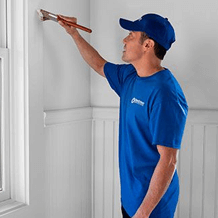
We are excited to announce that a long time Master Craftsman of our business is now the proud new owner; please join us in congratulating Earl Swader as the new owner of Handyman Connection of Blue Ash. Earl has previous business ownership already under his belt and is looking forward to continuing to serve the Blue Ash community as the proud owner.

Garage / April 9, 2026

Have you ever walked into your metal garage and wondered why the walls seem to be sweating? Many homeowners assume there must be a leak somewhere, but the real cause is often condensation.
When warm, humid air meets a cooler metal surface, moisture forms quickly. Fortunately, you can reduce the problem by controlling humidity levels and sealing gaps around the garage door to limit unwanted airflow. Here is an overview of how to solve your condensation problem.
The main reason for the sweating of metal garages has to do with dew point. Dew point is the temperature at which the moisture contained in the air can no longer remain in vapor form and will condense. Metal structures sweat due to their ability to heat up and cool down quickly.
During daylight hours, the structure of the metal garage is heated. At night, as the air temperature falls, the structure cools very quickly, allowing for condensation in the garage. The role of humidity is equally important. Sources of moisture include:
If the garage is poorly ventilated, there is no place for that moisture to go. In addition, if there are gaps in the structure, they may allow for humid air to enter the space.
Although condensation appears to be an insignificant issue, it is not. Over time, condensation will corrode tools and equipment, create mold, and destroy items like cardboard, fabrics, and wood.
The structure itself will degrade, shortening the lifespan of your garage as well. Over time, the effects of condensation on your metal garage will be obvious. Here are some tips to fix the issue.
You should understand the environment of your garage to ensure you are able to implement changes correctly. A hygrometer is a relatively inexpensive tool that can give you an indication of how humid your garage is.
Ideally, you should have humidity between 30%-50% inside your garage. If your readings continuously exceed those ranges, that moisture is definitely one of your problems and needs to be corrected immediately.
Air leaks are a common way for moisture to enter your garage. Even small gaps allow warm, moist air to enter your garage and then cool off when contacting the colder surface of your garage doors and roof.
Be sure to inspect your garage doors, roof seams, wall joints, and eaves. Replace worn weather stripping and seal any gaps to reduce the amount of outside air getting into your garage.
Ventilation can help reduce moisture. However, you must be careful with how you do it. Sometimes, simply opening your garage or structure may actually allow in more warm, humid air.
However, using a combination of ridge vent and soffit vent will allow more consistent air flow. Using exhaust fans will remove humidity from the air. The goal is to provide constant air circulation without continuously adding humidity to your garage.
Moisture can come from above, but sometimes it comes from below. If your garage has no moisture protection or has exposed dirt under it, then moisture from the ground can penetrate and rise up into the garage area.
Before installing flooring or on top of bare earth, it is essential to use vapor barriers. Vapour barriers serve as a crucial preventive measure against moisture infiltration, which can lead to issues such as mold growth, warping, and deterioration of flooring materials
Insulation is the solution to your condensation problem. It will reduce the temperature difference between the air and a cold steel surface, and therefore, prevent moisture from condensing.
Closed-cell spray foam insulation is effective largely due to its ability to insulate as well as seal cracks and create a moisture barrier. Closed-cell spray foam helps create a stable and consistent indoor climate, which is essential for comfort and energy efficiency.
Check out the guide to barndominium insulation in Houston, which provides a very informative explanation of the benefits of using insulation on pole barns. There are detailed instructions on how to apply the insulation and information about how thick to apply it.
When you experience large amounts of condensation regularly, or if your pole barn is used for purposes other than storage, consider applying spray foam insulation. Some of the indications of spray form include:
Spray foam insulation will provide a better overall solution to the problem than using multiple smaller solutions. While the initial application cost is more expensive, spray foam insulation can save you money in the long run.
A metal garage that sweats usually signals an imbalance between humidity and temperature inside the structure. Addressing condensation requires a combination of solutions, from sealing air leaks and improving ventilation to installing insulation and vapor barriers where needed.
Understanding how moisture enters your garage is vital for successfully controlling it. By taking proactive steps to manage temperature and humidity, you can transform your garage into a dry, reliable space, protecting your tools and equipment from rust and degradation.
For more tips on maintaining your property and upgrading your workspace, explore the latest guides on our home improvement blog.

11115 Kenwood Rd.
Blue Ash, OH 45242

© Handyman Connection 2026 | Privacy Policy

 (513) 771-3950