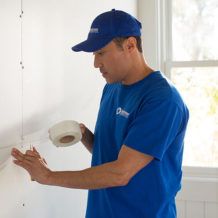
We are excited to announce that a long time Master Craftsman of our business is now the proud new owner; please join us in congratulating Earl Swader as the new owner of Handyman Connection of Blue Ash. Earl has previous business ownership already under his belt and is looking forward to continuing to serve the Blue Ash community as the proud owner.

Home Maintenance / September 10, 2026

Two people can book “a big clean” before moving out and get wildly different results. One gets their deposit back in full. The other gets an itemized deduction letter for the oven.
The difference usually is not effort. It is that move-out cleaning and deep cleaning are two different services solving two different problems, and most people book the wrong one.
Here is what separates them, what each actually includes, and how to sequence the repairs and the cleaning so you are not paying twice.
A move-out clean assumes the home is empty. That single assumption changes everything, because the crew can get inside cabinets, behind appliances and along baseboards that furniture normally blocks.
A deep clean assumes you still live there. It is a supplementary layer on top of regular cleaning, targeting the jobs that do not fit into a standard visit, such as washing cabinet fronts or taking down light fixtures.
If you book a deep clean for a move-out, you may not get the inside-appliance work that inspections hinge on. Book a move-out clean while your furniture is still in place and the crew cannot reach half the checklist. Getting this right is mostly about timing.
The kitchen is where deposits are won and lost. A proper move-out clean covers the inside and outside of the oven, microwave, dishwasher and refrigerator or freezer, plus all cabinets and drawers inside and out, countertops, backsplash and the sink and faucets.
Bathrooms get the shower and tub enclosure, inside and outside of the toilet, mirrors, soap dishes, reachable light fixtures, faucets and every empty cabinet and drawer. Floors are vacuumed then washed or scrubbed rather than just wiped.
Throughout the rest of the home, the list runs to the details inspectors actually look at. Baseboards, door frames and panels, windowsills, wainscoting, reachable ceiling fans and light fixtures, cobwebs, blinds, interior French doors, sliding glass doors, inside closets and the cold-air returns and vents.
For a genuinely empty property in the Alexandria area, Maid Brigade runs a move-out service built around exactly that checklist, and it serves Old Town, Del Ray, Rosemont, Potomac Yard, Arlandria, Cameron Station, Belle Haven, the West End and the Eisenhower Avenue corridor among others. Crews use HEPA-filter vacuums on carpet edges, hard floors and vent covers rather than standard machines, which matters in older homes where dust has had decades to settle.
They also offer PUREmist® disinfection as an add-on, an electrostatic mist that wraps around surfaces and objects for full coverage rather than only hitting the flat planes a cloth reaches. Additional charges apply for it, so ask when you request the estimate.
Every employee is screened, trained and insured, which is worth confirming with any company you call. An uninsured crew in an empty property you no longer control is a risk you do not need on moving week.
Deep cleaning is the category people misunderstand most, because it is not one fixed service. It is a menu of optional tasks you layer onto a regular clean, priced according to what your home actually needs.
In the kitchen that might mean the inside of the freezer, the area beneath the drip pans under the stovetop, washing cabinet fronts rather than wiping them, and washing out wastebaskets. In bathrooms it covers spot cleaning walls, wiping cabinets and washing interior windows.
Elsewhere the list is genuinely granular. Taking down and washing light fixtures, rolling up area rugs to clean underneath, removing books from shelves, vacuuming upholstery, mattresses, curtains and even stuffed animals with a HEPA vacuum, and cleaning out a fireplace that has been unused for at least 72 hours.
Because scope varies so much, most reputable companies will not quote a deep clean over the phone without details. Treat a firm flat price for deep cleaning as a reason to ask more questions, not fewer.
The practical way to book one is to name the two or three things that actually bother you rather than asking for “a deep clean” and hoping. Grease film above the range, hard water on the shower glass, dust on the ceiling fan blades in the bedroom.
That specificity gets you a sharper quote and a better result, because the crew arrives knowing where to spend the extra hour. A vague brief tends to produce a slightly better regular clean at a deep clean price.
It also helps to be realistic about what one visit can undo. Build-up that took three years to form will not always disappear in a single appointment, and a company that tells you so upfront is usually the one worth booking.
This is the sequencing mistake that costs people money. Cleaners arrive, do excellent work, and then a handyman comes in to patch nail holes and sand the repairs, filling the freshly cleaned room with drywall dust.
Do the repairs first. Nail holes, picture hook damage, doorknob dings, loose cabinet doors, a running toilet and anything you propped up with tape years ago and stopped noticing.
That last category deserves attention, because those temporary fixes are exactly what an inspector notices first. They read as deferred maintenance even when the underlying issue is small, and they are cheap to resolve properly if you deal with them before the walkthrough rather than during it.
Once repairs are done and the dust has settled, then bring in the cleaners. The order matters more than the calendar date.
Book the clean for after the movers leave and before the final walkthrough. Sounds obvious, and it is still the step most people compress into a single frantic day.
Give yourself a buffer of at least 24 hours between the clean and the inspection. If something was missed, you want the chance to raise it while the crew can still come back.
One more practical note. Confirm utilities stay connected through the cleaning date. A crew cannot mop floors or run a vacuum in a property where the water and power were cut off the day before.
Take photos. Walk the property after the clean and photograph every room, the inside of the oven, the inside of the refrigerator and the bathrooms, with a timestamp.
If a deduction is proposed later, a dated photo set ends the discussion faster than any argument about what “professionally cleaned” means. Keep the cleaning invoice with the photos.
The whole exercise is less about scrubbing harder and more about matching the right service to the right moment. Get the sequence right, get the scope right, and the last week in a home stops being the worst one.
No. A move-out clean is performed on an empty property and prioritizes inside appliances, inside cabinets and the detail surfaces inspectors check. A deep clean is an add-on layer for an occupied home.
It depends on square footage, number of bathrooms, pets and condition. Most companies quote after you describe the property, and many use an online estimate form for exactly that reason.
After. Cleaning around furniture and boxes means the crew cannot reach the surfaces that matter most, and you will likely need a second visit.
Usually not, provided the crew has access and the utilities are on. Arrange key handover and parking in advance, especially for apartment buildings with loading dock bookings.
Send your dated photos and the cleaning invoice. A documented professional clean makes a deduction much harder to justify, though specific rights vary by lease and jurisdiction.
You can, and for a small apartment in good condition it may be reasonable. For anything with a full oven, a fridge, multiple bathrooms or years of accumulated build-up, the hourly math usually favors hiring it out.

11115 Kenwood Rd.
Blue Ash, OH 45242

© Handyman Connection 2026 | Privacy Policy

 (513) 771-3950