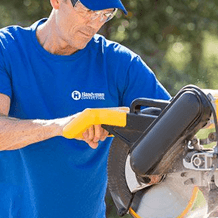
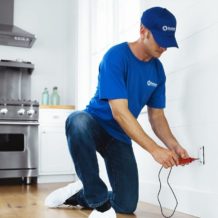
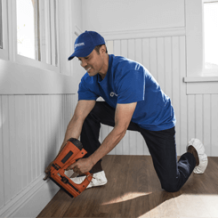
We are excited to announce that a long time Master Craftsman of our business is now the proud new owner; please join us in congratulating Earl Swader as the new owner of Handyman Connection of Blue Ash. Earl has previous business ownership already under his belt and is looking forward to continuing to serve the Blue Ash community as the proud owner.

Garage / September 18, 2026

The garage door is one of those things homeowners tend to troubleshoot themselves — a little WD-40 on a squeaky hinge, a quick tightening of a loose bolt, maybe a YouTube video for anything more involved. And honestly, a lot of minor garage door issues really are that simple. But the garage door is also the largest moving object in most homes, operating under serious spring tension, and a handful of warning signs mean it’s time to stop troubleshooting and call in a professional instead.
Here’s how to tell the difference.
Try this simple test: disconnect the opener (most have a manual release cord) and lift the door by hand. A properly balanced door should feel relatively light and stay in place when lifted halfway. If it feels unusually heavy, slams shut, or won’t hold its position, that typically points to a spring problem. This is one of the clearest signals to stop DIY-ing immediately — garage door springs are under enormous tension, and attempting to adjust or replace them without the right training and tools is a genuine safety risk, not just a difficult repair.
Some noise is normal — a bit of rattling or a mechanical hum from the opener motor. But a loud bang, a sharp pop, or persistent grinding usually indicates something more serious: a snapped spring, a cable that’s slipping off its drum, or worn rollers grinding against a track that’s no longer aligned properly. These sounds are the door telling you something has already failed or is actively failing, which is very different from routine wear that a little lubricant can fix.
If the door is sitting crooked, has visibly separated from its tracks, or moves unevenly on one side, this isn’t a simple adjustment. An off-track door usually means something has bent, warped, or come loose in the track or roller assembly, and forcing the door to keep operating in that state can cause further damage — to the door itself, the opener, or anyone nearby if it comes off the track entirely while in motion.
The cables that help lift and lower the door work in tandem with the springs, and they’re also under significant tension. If you notice fraying, visible slack, or a cable that’s come loose from its drum, this is not a DIY fix. Cable issues under tension can snap suddenly and forcefully, and replacing them safely requires releasing that tension in a controlled way — exactly the kind of task that calls for proper training.
Sometimes the motor hums, the opener light comes on, but the door doesn’t move, moves erratically, or stops partway. This can be an opener issue, a sensor misalignment, or a mechanical problem elsewhere in the system — and diagnosing which one it is isn’t always obvious without experience. Repeatedly forcing the opener to keep trying can burn out the motor or mask a more serious underlying mechanical issue.
Cosmetic damage might seem like it can wait, but dents and cracks can affect the door’s structural balance over time, and gaps where the door no longer seals against the frame let in drafts, moisture, and pests. If weatherstripping alone doesn’t solve a persistent gap, it may indicate the door itself has warped or shifted, which is a bigger fix than swapping out a seal.
Garage doors and their components have a realistic lifespan — springs are usually rated for a certain number of open-close cycles, openers have a comparable service life, and the door itself eventually shows wear that maintenance alone can’t reverse. If your garage door system is well past a decade old and you’re troubleshooting the same issues repeatedly, it may be more cost-effective in the long run to have a professional assess whether repair or replacement makes more sense, rather than continuing to patch an aging system piece by piece.
A good rule of thumb: minor issues like a squeaky hinge, a dirty track, or a loose bolt are reasonable to handle yourself. Anything involving springs, cables, the door coming off its track, or a system that’s making unfamiliar noises should go to a trained technician. If you’re in the San Diego area and noticing any of these warning signs, getting San Diego garage door repair from a licensed professional is a much safer route than troubleshooting a spring or cable issue yourself — the tools and training required to service these components safely aren’t something most home toolkits are set up for.
Garage doors operate under more mechanical tension than most people realize, which is exactly why some issues are perfectly fine to DIY and others genuinely aren’t. Learning to recognize the difference — balance problems, unusual noises, visible cable or track damage — protects both your home and your safety, and knowing when to hand a repair off to a professional is just as valuable a skill as knowing how to tighten a loose hinge yourself.

11115 Kenwood Rd.
Blue Ash, OH 45242

© Handyman Connection 2026 | Privacy Policy

 (513) 771-3950