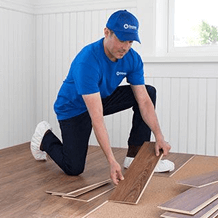
We are excited to announce that a long time Master Craftsman of our business is now the proud new owner; please join us in congratulating Earl Swader as the new owner of Handyman Connection of Blue Ash. Earl has previous business ownership already under his belt and is looking forward to continuing to serve the Blue Ash community as the proud owner.

Flooring / May 11, 2026

A squeaky board, small stain, loose tile, or minor carpet wrinkle does not always mean you need new floors. Many small issues can be repaired by a handyman. But when the problem affects a large area, keeps coming back, involves moisture, or points to damage beneath the surface, replacement may be the better long-term option.
For Pittsburgh-area homeowners, a handyman can often help with minor floor repairs. But for full flooring replacement, product selection, and professional installation, it makes sense to work with a flooring specialist like Molyneaux Home, which offers carpet, hardwood, laminate, luxury vinyl plank, luxury vinyl tile, ceramic tile, and area rugs in the Pittsburgh area.
The Repair vs. Replace Decision Framework
Before deciding, ask one main question:
Is this a surface-level problem, or is the flooring system failing?
A “flooring system” includes the visible floor, padding or underlayment, subfloor, and sometimes joists. A repair usually makes sense when the visible material is damaged but everything underneath is solid. Replacement becomes more likely when the issue is widespread, moisture-related, structural, or recurring.
| What You Notice | Likely Repair | Likely Replacement |
| One squeaky board | Yes | No |
| Squeaks across the whole room | Maybe | Yes |
| One small carpet stain | Yes | No |
| Carpet is matted, stained, and smelly | No | Yes |
| One cracked tile | Yes | Maybe |
| Multiple cracked tiles in the same area | No | Yes |
| Minor surface scratches | Yes | No |
| Warped, swollen, or buckled flooring | No | Yes |
| Damp smell after a leak | Maybe | Yes |
| Soft or sagging floor | No | Yes |
7 Signs Your Floors Need to Be Replaced
1. The Floor Squeaks in Several Places
A small squeak is common, especially in older homes. Wood expands and contracts, fasteners loosen, and boards can rub against each other. According to APA — The Engineered Wood Association, floor squeaks can come from issues such as improper spacing, incorrectly driven nails, joist problems, ductwork clearance, or poor connections between the subfloor and finish flooring.
A handyman may be able to fix a localized squeak by securing loose boards, adding screws, or tightening the subfloor from below.
But squeaks become more serious when they are widespread.
When noise comes with movement, the problem may be underneath the finished floor. In that case, simply repairing the top layer may not solve the issue.
2. Water Damage Has Warped or Swollen the Flooring
Water damage is one of the biggest reasons floors need replacement instead of repair. A small spill that is cleaned quickly may not cause lasting damage. But moisture that soaks into wood, laminate, carpet padding, or subflooring can create bigger problems.
The EPA recommends acting quickly after leaks or spills. Wet or damp materials should be dried within 24 to 48 hours to help prevent mold growth. The EPA also notes that moisture control is key to mold control inside the home.
| Sign | What It Could Mean |
| Cupped hardwood | Moisture has entered the wood |
| Buckled planks | Flooring has expanded from water exposure |
| Swollen laminate seams | The core material absorbed moisture |
| Musty odor | Carpet padding or subfloor may be damp |
| Dark stains | Water may have sat too long |
| Soft spots | Subfloor may be weakened |
A handyman may be able to patch a small damaged area, but if flooring is swollen, buckled, musty, or soft, replacement is usually more practical.
3. Carpet Looks Worn Even After Cleaning
Carpets can hide problems for a while. It may look fine under furniture but show heavy wear in hallways, stairs, bedrooms, and family rooms. Once carpet fibers are crushed, backing is exposed, or padding is worn out, cleaning will not fully restore it.
The NAHB life expectancy study lists carpet at about 8 to 10 years with appropriate maintenance and normal traffic. The same study lists laminate at 15 to 25 years, vinyl up to 50 years, tile at 75 to 100 years, and many wood floors as lifetime materials depending on quality and care.
A small patch or carpet stretch may help in isolated cases. But if carpet is old, stained, loose, or holding odor, replacement is usually the better investment.
4. The Floor Feels Soft, Spongy, or Uneven
A soft floor is different from a scratched floor. Scratches are cosmetic. Softness can point to a problem below the surface.
A handyman may repair a small subfloor section, but widespread softness should be inspected before any new material is installed.
5. Repairs Keep Coming Back
One repair is normal. Repeated repairs are a warning sign.
If you keep fixing the same squeak, patching the same tile area, re-stretching carpet, or covering damage with rugs, the floor may be beyond spot repairs.
| Pattern | What It Suggests |
| Same squeak returns | Subfloor or fastening issue |
| Carpet ripples repeatedly | Padding or installation failure |
| Tiles crack in one area | Movement underneath |
| Stains keep resurfacing | Moisture or deep-set contamination |
| Boards separate again | Humidity, movement, or installation issue |
Professional flooring installation costs vary widely, but Angi’s 2026 flooring data lists a common professional installation range of $1,528 to $4,860, depending on room size, flooring type, and local labor.
That does not mean replacement is always cheaper immediately. But if repair costs keep stacking up, replacement can become the more practical long-term decision.
6. The Flooring No Longer Fits the Room
Sometimes the floor does not completely fail — it is just the wrong material for the space.
For example:
This is where material selection matters.
Molyneaux Home’s flooring pages highlight options such as
Their luxury vinyl page notes that luxury vinyl plank is popular for homeowners who want a wood look at a more cost-effective price point, and describes their LVP options as waterproof and suitable for high foot traffic and pets.
For Pittsburgh homeowners dealing with snow, rain, mud, pets, kids, and seasonal humidity, choosing the right material can reduce future repair issues.
7. The Floor Is Hurting the Look and Value of the Home
Floors have a major effect on how a home feels. Worn carpet, outdated vinyl, stained hardwood, cracked tile, and uneven transitions can make an otherwise clean room feel neglected.
Replacement may be worth considering if:
A handyman can help with trim, transitions, minor patches, and prep work. But if the goal is a full room transformation, a flooring specialist is usually the better fit.
Handyman or Flooring Specialist?
Use this table to guide the next call.
| Job Type | Call a Handyman | Call a Flooring Specialist |
| Fix one squeaky board | Yes | Maybe |
| Replace one damaged plank | Yes | Maybe |
| Stretch small carpet ripple | Yes | Maybe |
| Patch small vinyl damage | Yes | Maybe |
| Replace carpet in a full room | No | Yes |
| Install hardwood or LVP | No | Yes |
| Address water-damaged flooring | No | Yes |
| Choose new flooring material | No | Yes |
| Install flooring across multiple rooms | No | Yes |
Not every damaged floor needs to be replaced. If the issue is small, isolated, dry, and cosmetic, a handyman may be able to fix it quickly. But if the problem involves moisture, odor, soft spots, widespread squeaking, repeated repairs, or worn-out carpet, replacement is often the smarter move.
The key is to look beyond the surface. A scratch is usually a repair. A soft, swollen, musty, or unstable floor may be a system failure.
For minor fixes, call a handyman. For full replacement, design guidance, and professional installation, Pittsburgh-area homeowners can turn to a flooring specialist like Molyneaux Home.

11115 Kenwood Rd.
Blue Ash, OH 45242

© Handyman Connection 2026 | Privacy Policy

 (513) 771-3950