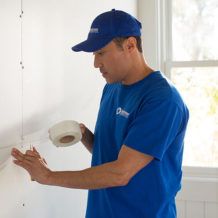
We are excited to announce that a long time Master Craftsman of our business is now the proud new owner; please join us in congratulating Earl Swader as the new owner of Handyman Connection of Blue Ash. Earl has previous business ownership already under his belt and is looking forward to continuing to serve the Blue Ash community as the proud owner.

Uncategorized / March 25, 2026

Wood-epoxy fabrication involves the infusion of thermosetting resins into porous substrates. This process requires adherence to ISO benchmarks for polymer adhesion and timber stability. High-precision manufacturing ensures that the material maintains structural integrity under environmental loads. Detailed engineering data regarding these builds is accessible at https://maxiwoods.com/collections/epoxy-conference-tables. The manufacturing cycle begins with the dehydration of the wood to reach a fiber saturation point below 10%. This prevents water vapor bubbles during the chemical transition to a solid mass. Adhering to cooling curves prevents internal stresses. Constant facility temperature prevents localized variations in curing speed.
Moisture content (MC) is the primary variable affecting the bond between wood and epoxy resin. Industrial protocols mandate that all timber must be kiln-dried to a moisture content of 6% to 9%. This range is measured using pin-type moisture meters calibrated for the specific gravity of the species. At this level, the wood reaches an equilibrium moisture content suitable for indoor climates with 40% relative humidity. Lowering the MC below 6% leads to brittle cell walls, while exceeding 10% risks delamination due to poor resin adhesion. Surface preparation involves removing oils using 80-grit abrasives, increasing the area for mechanical interlocking through deep penetration.
The chemical reaction relies on the precise mixing of epoxy resin and amine-based hardeners. Stoichiometric accuracy must be maintained within a 1% margin by weight to ensure complete cross-linking of the polymer chains. Incomplete mixing results in soft spots where the polymer remains semi-liquid, compromising the mechanical load-bearing capacity. Industrial mixers rotate at 50 to 100 RPM to combine components without introducing air. Following mixing, the resin is placed in a vacuum chamber at 29 inches of mercury to remove dissolved gases. This eliminates micro-voids that act as stress concentrators during usage. Precise viscosity control allows for optimal capillary action into the timber grain.
Curing large volumes of epoxy produces an exothermic reaction that generates internal heat. For pours exceeding 50 millimeters, the internal temperature must stay below 65 degrees Celsius. If temperatures exceed this threshold, the resin undergoes thermal degradation, resulting in a yellow tint or internal fractures known as shrinkage cracks. Specialized low-exotherm resins are formulated with slower reactivity to extend the gel time up to 72 hours, allowing heat to dissipate through the mold walls. Maintaining a constant ambient temperature of 21 degrees Celsius prevents localized thermal gradients that cause uneven curing across the volume. This controlled thermal dissipation prevents catastrophic failure of the polymer matrix.
The durability of a wood-epoxy surface is quantified using the Shore D hardness test according to ASTM D2240 standards. A cured composite must reach a hardness value between 82 and 86 to resist mechanical indentation. Flexural strength is assessed using the ASTM D790 three-point bending test to determine the modulus of rupture. For industrial applications, the MOR must exceed 10,000 PSI to support heavy equipment. These tests verify that the bond at the interface is stronger than the internal cohesive strength of the wood fibers. Regular calibration of testing equipment ensures data accuracy across different batches. These metrics are vital for determining the safe working load.
Surface finishing for composites follows a sequence of mechanical sanding to achieve a specific roughness average. Technicians use pneumatic sanders starting at 120-grit and progressing to 400-grit to eliminate tooling marks. Between each stage, the surface is cleaned with denatured alcohol to remove residual dust. The protective layer consists of a two-component aliphatic polyurethane that provides high resistance to ultraviolet radiation and chemical staining. This coating must pass the ASTM D1308 test for resistance to household reagents like ethanol or acetic acid. A final gloss meter reading confirms that the light reflectance is consistent. Proper surface preparation prevents the peeling of topcoats over time.
Final installation requires metal support structures capable of bearing weights exceeding 15 kilograms per square meter. Frames are constructed from powder-coated steel with leveling feet to ensure a horizontal plane within 0.1 degrees. Fasteners are installed through oversized holes to allow for the differential thermal expansion between the wood-epoxy panel and the frame. This detail prevents the assembly from buckling when exposed to temperature changes. These protocols are vital when configuring workstations for office environments where equipment stability is a requirement. Airflow around the installation prevents heat buildup, maintaining the material’s structural integrity over long years. This systematic approach ensures architectural compliance and user safety.

11115 Kenwood Rd.
Blue Ash, OH 45242

© Handyman Connection 2026 | Privacy Policy

 (513) 771-3950