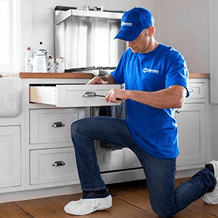
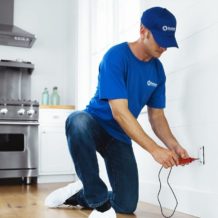
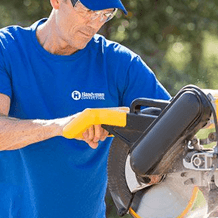
We are excited to announce that a long time Master Craftsman of our business is now the proud new owner; please join us in congratulating Earl Swader as the new owner of Handyman Connection of Blue Ash. Earl has previous business ownership already under his belt and is looking forward to continuing to serve the Blue Ash community as the proud owner.

Maintenance / February 20, 2026

Service centers dealing with household appliance repairs operate under constant time pressure. Phone calls, paper requests, Excel spreadsheets with customer addresses, handwritten technician schedules — all this eats up time that could be spent on actual work. Industry research shows that the average technician loses up to 90 minutes daily just coordinating tasks and searching for information about previous calls.
This article examines practical ways to implement automation in the daily operations of service centers, from call dispatching to spare parts inventory management.
The traditional request intake scheme in companies that operate without appliance repair software looks like this: customer calls, dispatcher writes down details in a notebook or computer, then calls the technician, technician confirms the time, dispatcher contacts the customer again. Three calls per single request, minimum five minutes of pure time, not counting situations when the technician doesn’t answer or the customer changes their mind.
Online booking systems let customers independently select a convenient technician visit time through a web form or mobile app. The calendar automatically displays available slots considering the property’s geographic location and technician workload. If a refrigerator breaks down in Cologne, the system won’t suggest a technician working in Düsseldorf that day.
ServiceTitan, one of the largest platforms for service companies in the US, reports their clients see a 23% increase in request conversion after implementing automatic booking. People are more willing to submit a request at 11 PM through a website form than wait until morning to make a phone call.
Integration with IP telephony adds another efficiency layer. An incoming call automatically opens the customer card with previous contact history, appliance models, and address. The dispatcher sees all necessary information on screen before picking up the receiver.
Picture a typical workday for a mobile technician in a large city. Six or seven calls scattered across different neighborhoods. Without thoughtful logistics, half the day goes to sitting in traffic.
Routing systems analyze the geolocation of all scheduled properties and build an optimal path accounting for real-time traffic. Google Maps API algorithms or similar solutions have long learned to predict congestion and suggest alternatives. Average time savings — roughly an hour per day per technician. Over a month, that’s 20-22 hours that can be used for additional calls.
Company vehicle GPS tracking solves another problem — transparency for customers. Similar to how Uber shows where your driver is, modern service apps allow tracking the technician’s movement. The customer receives an SMS: “John will arrive in 12 minutes,” and sees a dot on the map. This drastically cuts down calls like “When is the technician coming?”
Verizon Connect conducted a study among 500 service firms and found that GPS monitoring reduces fuel costs by an average of 15% and cuts vehicle idle time by 30%. Technicians stop making unnecessary loops around neighborhoods searching for addresses and respond faster to urgent calls.
A situation familiar to every service owner: technician arrives at the property, diagnoses the malfunction, but the needed part isn’t in their van or at the warehouse. Repeat visit, lost time, dissatisfied customer.
Smart inventory systems track stock in real time. When a technician takes a part from the warehouse, the system automatically records it through a mobile app with a barcode scanner. Stock levels update instantly. If the quantity of a specific component drops below the established minimum, the program sends a notification to the manager or even automatically generates a supplier order.
Some platforms integrate directly with manufacturer catalogs — Samsung, LG, Bosch. Click on the washing machine model, select the needed part, the system shows current price and availability at distributors. The ordering process takes a minute instead of traditional phone negotiations and article number clarifications.
Parts consumption analytics help forecast needs. If statistics show that heating elements for washing machines run out every two weeks, the system will suggest increasing the permanent stock. Amazon uses similar predictive models in its logistics, placing popular products closer to regions with highest demand.
Field Complete offers comprehensive solutions for managing field service operations, including inventory tracking that helps technicians know exactly what parts they have before arriving at a job site.
An experienced technician keeps hundreds of repair nuances for different appliance models in their head. A novice without such knowledge baggage makes mistakes, skips important diagnostic steps, wastes time searching for information online.
Structured checklists in a mobile app standardize the process. For each malfunction type — step-by-step instructions with photos and videos. The technician simply moves through the points, marking completed actions. The system won’t let them close the request until all mandatory stages are passed: power supply check, control board diagnostics, post-repair testing.
The knowledge base accumulates history of all cases. Unusual Liebherr refrigerator malfunction? Enter the model and symptoms — the system shows whether colleagues encountered this before, which solutions worked. This proves especially valuable for rare premium appliance models, whose documentation may only be available in English or German.
Video instructions become standard. RepairClinic has assembled a library of over 100,000 video guides for household appliance repairs. A technician right on site can watch a clip about replacing a pump in a specific dishwasher model to avoid missing important details.
Invoicing and payment collection often turn into a separate headache. Technician completes work, writes a receipt by hand, passes it to accounting, they enter data into the computer, generate an invoice, send it to the customer, then track payment.
Integrated payment systems allow accepting payment right on site through a terminal or online after work completion. The technician presses “Complete Order” in the app, the customer instantly receives an invoice by email or SMS with a link to pay by card. Stripe, Square, and similar processors handle the transaction in seconds.
Automatic payment reminders reduce overdue debt. If the customer hasn’t paid within three days, the system sends a polite reminder. After a week — another one. Most people simply forget to pay rather than deliberately avoid it.
Reporting generates automatically. How much did each technician earn per month? Which repair types are most profitable? What’s the average call cost? The dashboard shows all key metrics in real time, without needing to manually compile Excel tables. QuickBooks and other accounting programs sync with service platforms, automatically reflecting all transactions.
Most household appliance owners contact service only when something breaks. Then they forget about the company until the next breakdown. Or they don’t forget — they choose another firm that appeared first in Google.
CRM systems for service centers automate customer communication throughout the entire lifecycle. Washing machine repaired in January? The system will send an SMS in July reminding about preventive maintenance. Dishwasher purchased three years ago? The customer receives a message that the manufacturer’s warranty expires soon, worth checking component condition.
Personalized offers increase repeat contacts. If the database shows the customer has a 10-year-old Samsung refrigerator, you can propose a special diagnostic price before summer season when the load is maximum. Or a discount on installing a new appliance with a trade-in program for the old one.
Automatic surveys after work completion collect reviews without manager participation. A day later, the customer receives a short form: rate the technician’s work, completion speed, repair quality. Positive reviews can automatically publish to Google Maps or Facebook, negative ones — direct to management for problem resolution before it becomes public.
HubSpot analyzed 7,000 companies and found that email marketing automation increases customer retention rate by 14% in the first year of use. For service business, where attracting a new customer costs 5-7 times more than retaining an existing one, this represents substantial savings.
Machine learning technologies gradually penetrate even the household appliance repair sphere. Startup Streem developed an AR app that allows customers to show a malfunction through their smartphone camera to a remote specialist. AI analyzes video in real time, suggests possible causes and solutions.
Chatbots process simple inquiries around the clock. Refrigerator not cooling? The bot asks a series of clarifying questions, possibly suggests a simple solution (check if ventilation holes are blocked), or creates a technician visit request. This unloads dispatchers who handle more complex cases.
Predictive analytics helps anticipate breakdowns. If a washing machine of a certain model typically needs bearing replacement after 8-10 years of operation, the system can proactively offer the customer diagnostics. This works better than advertising: the person understands they’re being caringly reminded about a potential problem, not just being sold a service.
GE Appliances implemented Connected Care technology in their smart devices. The washing machine independently sends telemetry to the manufacturer, algorithms detect operational anomalies before complete breakdown. The customer receives notification: worth ordering preventive maintenance, otherwise in a week or two a serious malfunction is possible.
Transitioning to automated processes doesn’t mean immediately throwing out all paper logs and forcing staff to master complex software over a weekend. The smart approach is gradual.
Start with bottleneck analysis. Where are the biggest time losses? Where do errors occur most frequently? If the problem is confusion with technician schedules — implement dispatching first. If customers complain about waiting for visits — GPS tracking and online booking.
Test on a small portion of processes. Choose one technician or one service for a pilot project. See how the system works in real conditions, collect feedback from employees and customers. This costs less and carries less risk than immediately converting the entire business to a new platform.
Staff training proves critically important. The best software will be useless if technicians don’t understand how to use it or resist changes. Conduct trainings, create internal instructions, assign a responsible person who can be approached with questions.
Integration with existing tools saves time and money. If certain accounting software or CRM is already in use, look for service software that can sync with them. Open APIs and ready-made connectors simplify merging different systems into a unified ecosystem.
Numbers demonstrate the effect of implementing technology better than words. Air Patrol AC in Texas, after switching to Housecall Pro, increased completed orders by 60% over a year without hiring additional staff. Average time from request to technician visit shortened from 48 to 24 hours.
One Hour Heating & Air Conditioning, a network of 50+ franchises, recorded an 18% increase in average ticket thanks to automated upselling. The system analyzes customer equipment age and suggests relevant additional services to technicians right in the mobile app during visits.
Smaller services see benefits too. A solo technician from London shared in a Tech Advisor interview that after implementing Jobber, income grew 30% while working hours remained the same. Schedule and route automation allowed taking more calls per day and spending less time traveling.
Return on investment typically comes quickly. Most platforms work on a subscription model — $50-200 monthly depending on functionality and user count. If automation enables servicing even 2-3 additional clients weekly, the system pays for itself in the first month.
Service process automation stopped being a privilege of large corporations. Cloud technologies made powerful tools accessible even to small workshops. The only question is readiness to change familiar work processes and invest time in system setup. Those who took this step gain a competitive advantage that only grows over time while others continue working the old way.
11115 Kenwood Rd.
Blue Ash, OH 45242

© Handyman Connection 2026 | Privacy Policy

 (513) 771-3950