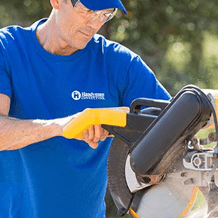
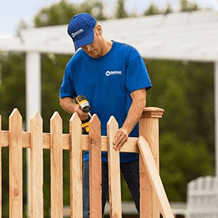
We are excited to announce that a long time Master Craftsman of our business is now the proud new owner; please join us in congratulating Earl Swader as the new owner of Handyman Connection of Blue Ash. Earl has previous business ownership already under his belt and is looking forward to continuing to serve the Blue Ash community as the proud owner.

Fencing / November 18, 2026

Every wood fence starts out looking great. Then one spring, there’s a board that’s a little gray, a post that’s a little crooked, and a gate that has to be lifted to latch. Before deciding whether to repair, refinish, or replace, most homeowners want to know one thing: how long does a wood fence last?
Most wood fences last about 10 to 30 years. Pressure-treated pine usually lands around 10 to 20 years, while cedar and redwood often reach 15 to 30 years or more with regular sealing and staining.
That’s a wide range, and where a fence falls in it isn’t luck. The type of wood matters, but so do the climate, the way the posts were set, and how much attention the fence gets once it’s up. A little knowledge here can add years to a fence or save money on the next one.
Pressure-treated pine is the budget-friendly workhorse of the fence world. The treatment helps it resist rot and insects, and with regular staining it can hold up for 15 to 20 years. Left alone, it tends to show its age sooner.
Cedar costs more, but it brings natural oils that help it resist moisture, rot, and bugs. That’s a big reason cedar fences commonly last 15 to 30 years, and well-maintained ones can go longer.
Redwood sits at the top of the list for many homeowners. It’s naturally durable, it looks great, and in drier climates it can stretch past the 25-year mark. It’s also usually the priciest of the three.
One thing all three have in common: untreated, unmaintained wood ages fast. Even the best boards will gray, crack, and warp if they’re left to fend for themselves.
Wood fences rarely fail all at once. They wear down a little at a time, usually because of a few repeat offenders:
Posts deserve special mention. They’re usually the first part of a fence to go, because they spend their entire lives in contact with damp soil. A fence with great-looking boards can still lean or wobble if the posts underneath are rotting.
Climate plays a big role too. A cedar fence in a dry, mild area may easily outlast the same fence in a damp, humid region or a place with long, snowy winters. That’s why two neighbors in different parts of the country can have completely different experiences with the exact same wood, and why local conditions should shape how a fence is built and cared for.
A wood fence’s lifespan is decided on day one, long before the first coat of stain. Posts need to be set deep enough for the local soil and frost line, with good drainage so water doesn’t pool around the base. Boards should sit a little above the ground instead of touching it. And the hardware, from nails and screws to hinges and latches, should be rated for outdoor use so it doesn’t rust and stain the wood.
Skip any of those steps, and even premium cedar can start sagging within a few seasons. That’s why it pays to get solid wood fence installation guidance before starting a new project, whether that means hiring a crew or simply learning what a proper install should look like. Knowing what good post-setting, spacing, and drainage look like makes it much easier to spot shortcuts in a quote.
The good news is that most of what keeps a wood fence going is easy. A little routine care goes a long way.
Seal or stain the fence every few years. A quality sealer or stain helps block moisture and UV damage, and it keeps the wood looking fresh. Many homeowners plan on every two to three years, though the right timing depends on the product and the weather.
Keep things clear. Trim back shrubs and vines that trap moisture against the boards, and point sprinklers away from the fence line. Rake leaves and mulch away from the base so the bottom of the fence can dry out.
Do a quick walk-around once or twice a year. Look for loose boards, popped nails, soft spots, and posts that move when pushed. Catching a problem early usually means swapping one board instead of rebuilding a whole section.
Not every tired-looking fence needs to come down. If the posts are solid and only a few boards are damaged, replacing those boards and refinishing the whole fence can buy years of extra life for a fraction of the cost of a new one.
Gray, weathered boards are often a cosmetic problem, not a structural one. A good cleaning and a fresh coat of stain can bring a surprising amount of color back.
Replacement starts to make more sense when several posts are rotting, large sections are leaning, or the fence needs more repairs every season. At that point, patching becomes a never-ending project, and a new fence built the right way from the ground up is usually the better investment.
Now that the typical lifespan is clear, the best next step is to see where your own fence stands. Take 15 minutes this weekend to walk the fence line, push on each post, and check the bottom of the boards, then decide whether it needs a little maintenance, a few repairs, or a plan for replacement.

11115 Kenwood Rd.
Blue Ash, OH 45242

© Handyman Connection 2026 | Privacy Policy

 (513) 771-3950