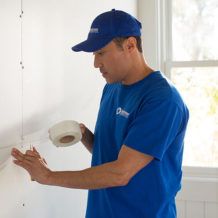
We are excited to announce that a long time Master Craftsman of our business is now the proud new owner; please join us in congratulating Earl Swader as the new owner of Handyman Connection of Blue Ash. Earl has previous business ownership already under his belt and is looking forward to continuing to serve the Blue Ash community as the proud owner.

Drywall / October 15, 2025

Whether commercial drywall access doors need to be fire-rated depends on where they’re installed. If the wall or ceiling is fire-rated, so should the access doors.
Fire compliance is not optional in commercial construction; it’s a legal requirement that preserves fire barriers. Drywall access doors installed in a wall assembly can make or break that wall’s performance under fire conditions.
Therefore, while not every drywall application calls for fire resistance, knowing when it does is important for compliance. Let’s break it down.
What Is a Fire-Rated Drywall Access Door?
A fire-rated drywall access door is a specialized panel designed to maintain the fire-resistance rating of the wall where it’s installed. Unlike standard doors, these units are tested and certified—often to UL standards—to slow the spread of fire and smoke.
In practice, this means the door won’t become the weak link in a fire barrier. The frame, hardware, and core materials are designed to withstand high heat and flame exposure, featuring insulated cores, tight seals, and secure latching mechanisms.
On the other hand, standard drywall access doors are meant for convenience and easy access. They disappear into walls aesthetically but will not hold back fire.
When Do Building Codes Require Fire-Rated Access Doors?
Building codes require fire-rated access doors whenever the wall assembly carries a fire-resistance rating. If a wall is designed as a fire barrier, smoke partition, or rated shaft enclosure, the access door installed must match that rating.
The logic is straightforward. If the wall is supposed to resist fire for 60, 90, or 120 minutes, but the door collapses in 10, the barrier fails. This is why most codes, including the International Building Code (IBC), demand that openings in rated walls use listed and labelled fire-rated assemblies.
In commercial settings, fire-rated drywall access doors often appear in high-risk areas like:
The code language may vary by jurisdiction, but the principle remains the same: if the wall is rated, the door must be rated.
On the flip side, using non-rated drywall access doors on rated walls carries practical and legal risks. Practically, the wall will no longer hold back fire, allowing flames and smoke to spread unchecked. This means less time for occupants and first responders.
Legally, it can lead to code violations, failed inspections, and liability for damages if a fire occurs.
This makes choosing the right panel vital for contractors and facility managers. One wrong product choice can expose a project to rework, delays, and legal penalties.
What Should You Consider When Specifying Drywall Access Doors?
As mentioned earlier, the most important rule is alignment when specifying drywall access doors. The door’s fire rating must match the wall assembly’s fire rating. For contractors, it’s important to confirm the wall assembly’s rating so they can specify the right panel.
Beyond that, professionals should:
Architects, engineers, and contractors each play a role. Architects specify intent, engineers confirm assemblies, and contractors ensure installation meets code. Together, they preserve the wall’s integrity and ensure compliance.
What Benefits Do Fire-Rated Access Doors Offer Beyond Compliance?
Beyond compliance, fire-rated drywall access doors enhance everyday building performance.
Conclusion
Commercial drywall access doors only need to be fire-rated when the wall they’re installed in is fire-rated. In those situations, fire-rated access doors ensure compliance by maintaining the integrity of fire barriers and following building codes.
For commercial construction professionals, the key is to specify access doors that match the wall assembly ratings. It’s also important to check for certifications to ensure the quality of fire-rated access doors before purchase.
Overall, choosing the right drywall access panels helps avoid project delays and keeps budgets on track.

11115 Kenwood Rd.
Blue Ash, OH 45242

© Handyman Connection 2026 | Privacy Policy

 (513) 771-3950