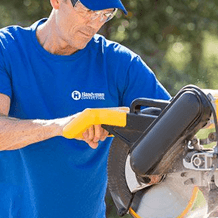
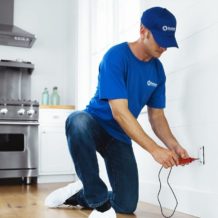
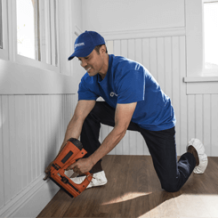
We are excited to announce that a long time Master Craftsman of our business is now the proud new owner; please join us in congratulating Earl Swader as the new owner of Handyman Connection of Blue Ash. Earl has previous business ownership already under his belt and is looking forward to continuing to serve the Blue Ash community as the proud owner.

Carpentry / April 13, 2026

You lock your door every day, yet small hardware gaps still leave it exposed to unauthorized access. Most of today’s break-ins rely on weak entry points, not advanced tools or tricks you employed.
So if you fix the right spots, you can boost your entry security before burglars target your home. In most cases, simple upgrades will just cost you a little less than an hour, yet they can already make your home far harder to break into.
Your lock will only be as strong as the plate it hits. Some homeowners still use thin plates held by short screws that tear out under force; you may not want this to happen in your home.
So, switch to a heavy-duty strike plate, then anchor it into the wall stud. This spreads impact across solid framing, not just trim wood, which often fails first.
Swap in 3 Inch Screws for Real Holding Power
Most factory screws are about one inch long. That barely grips your door’s frame.
Replace them with 3-inch hardened screws.
You’ll feel the difference when tightening, and anyone trying to kick the door in.
Extend Deadbolt Throw for Deeper Bite
A deadbolt that extends only a short distance is easier to force back. You want a throw of at least one inch.
If your current lock falls short, upgrade the mechanism. If you’re around Nueces County in Texas and quite unsure what fits your door, a 24hr locksmith in Corpus Christi can quickly assess compatibility and install the right hardware for your setup.
Install a Door Viewer Before You Open
Opening the doorway blindly is still a common mistake and is quite dangerous. A simple peephole or wide-angle viewer fixes that.
Modern viewers offer 180-degree visibility. This lets you confirm who is outside without unlocking anything, which reduces social engineering risks.
Add Hinge Security Pins on Outward Doors
If your door swings outward, your hinges sit exposed. That makes them a weak point.
Security pins prevent hinge removal even if someone pulls the hinge pin.
It’s a small upgrade, but it closes a major oversight many homes have.
Shield the Door Jamb from Splitting
The door jamb often cracks before the lock fails, especially if you’ve had a bout of sticking doors every Spring that led to misaligned hinges and worn-out materials. That’s what intruders count on.
A metal jamb shield reinforces this area. It spreads force along the frame, making kick-ins much harder and louder.
Turn On Smart Lock Auto Lock Features
Smart locks are convenient, but many users forget to enable auto-lock. That leaves doors open longer than intended.
Enable timed locking after 30 to 60 seconds or use auto-locking features to make sure everyone is safe inside at home, or even if you’re suddenly called out on an emergency.
Use Keypad Privacy Mode for Extra Control
If your lock has a keypad, use privacy mode when you’re home or sleeping. It’ll help you disable external code entry.
It gives you full control from inside, which adds a second layer of intent verification before entry.
Upgrade to High Security Lock Cylinders
Some doors’ standard cylinders can be picked or bumped with basic tools. Using high security versions, however, can be quite effective in resisting both.
Look for features like anti-drill pins and restricted keyways. These upgrades are common in commercial settings, but work just as well for homes.
Control Who Has Copies of Your Keys
Often, your lost or copied keys can pose silent risks. Some break-ins and burglaries happen without traces of forced entry because someone unscrupulous kept a duplicate without your knowledge.
Rekey your locks after moving in or after lending your keys. If needed, services like an emergency locksmith can reset your system quickly, especially when access control becomes unclear.
Secure Sliding Doors with a Pin or Bar
Sliding doors are often overlooked. Their latches are easy to bypass. Install a steel pin or a track bar.
This physically blocks movement, even if the lock is compromised.
Lock Your Garage Side Door Properly
Many people secure the main door but ignore the garage entry. That door often has weaker hardware.
Treat it like your front door. Use a deadbolt, reinforced strike plate, and solid screws to match your main entry security level.
Store Spare Keys in a Weatherproof Lockbox
Hiding keys under mats or pots is still common and easy to guess. Burglars know these spots.
A mounted lockbox with a code is safer. It protects access while keeping it available for trusted people during emergencies.
You don’t need complex systems to feel safer at home; you need smarter details that work together. Each small upgrade, from longer screws to reinforced plates, adds real resistance that slows down forced entry and draws attention.
That delay alone can already make intruders give up and leave your door alone. Think of it as a well-built system, not just a single lock. When the frame, hinges, and hardware all work for each other, your security multiplies.
Just start with one door fix today, then build from there. Your goal: make your home look and feel like it needs too much effort to break into.

11115 Kenwood Rd.
Blue Ash, OH 45242

© Handyman Connection 2026 | Privacy Policy

 (513) 771-3950