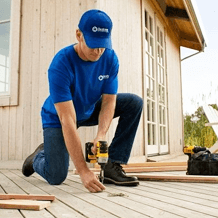
We are excited to announce that a long time Master Craftsman of our business is now the proud new owner; please join us in congratulating Earl Swader as the new owner of Handyman Connection of Blue Ash. Earl has previous business ownership already under his belt and is looking forward to continuing to serve the Blue Ash community as the proud owner.

Home Maintenance>Repairs / June 3, 2026

Most homeowners know not to hand a stranger thousands of dollars. The problem is that scams rarely look like scams anymore.
Sometimes it is a phone call. Sometimes it is a text message. Sometimes it is somebody standing at your front door wearing a safety vest and carrying a clipboard.
A lot of the newest scams are really just old scams wearing better disguises.
The caller claims your power is about to be disconnected. You need to pay immediately.
The urgency is usually the giveaway.
Most people are caught off guard because the call sounds official. The person on the other end already seems to know who they are and where they live. Before long, the conversation turns into pressure.
That pressure is usually the point.
The phone number looks local. The caller sounds professional. That does not always mean either one is real.
If an unexpected contractor calls, a free reverse phone lookup can help verify who is actually behind the number before you continue the conversation.
A local area code is surprisingly easy to fake. A lot of people trust the number before they think about the person calling.
They just finished a job nearby. They have extra materials. They can give you a special deal today.
Convenient, right?
Sometimes a little too convenient.
Maybe they really were working nearby. Maybe they were not. Either way, the pressure to make a decision right now is usually the part worth paying attention to.
This scam somehow survives every year. Somebody claims they have leftover material and can seal your driveway for cheap.
The story always sounds reasonable. Why waste perfectly good material?
Unfortunately, some homeowners end up paying for work that looks rushed, thin, or starts breaking down much sooner than expected.
Everything is fine until the contractor suddenly needs another few hundred dollars for permits.
Then the project cannot move forward without it. Sometimes permits really are required.
The problem is that some people do not ask questions because they assume the contractor must know best. That extra charge can appear awfully fast once work has already started.
Someone sends too much money. Then they need part of it back immediately.
This scam has been around forever because it sounds like an honest mistake.
Most people want to help fix the problem. Unfortunately, the original payment sometimes turns out to be the real problem.
Your warranty is expiring. Apparently.
Even though you have no idea which warranty they are talking about.
Most people have received some version of this call before. The details are usually vague, but the urgency never is.
Funny how that works.
The inspection costs almost nothing. The repair estimate costs a lot more.
It seems more than a little suspicious.
Sometimes the technician is only in the house for a few minutes before discovering a long list of expensive problems. Suddenly everything needs immediate attention.
Maybe it does. Maybe it does not.
The voice sounds familiar. That is exactly the point.
Voice-cloning technology is getting better, and scammers know it. A call that sounds like a contractor, spouse, or business contact can catch people off guard quickly.
When money is involved, it never hurts to verify the request another way.
Scan here. Verify this. Update that.
The QR code is often the entire scam.
A lot of people automatically trust QR codes because they look modern and convenient. Scammers know that too.
Your invoice is overdue. Your payment failed. Your appointment changed.
The message usually creates just enough concern to make somebody click before thinking. That is all the scammer really needs.
Someone says they need access to inspect something.
Maybe it is HVAC equipment. Maybe it is a utility meter. Maybe it is something else entirely.
If you were not expecting the visit, there is nothing wrong with making a phone call first. Most legitimate companies will not be offended by a homeowner wanting to verify who is standing at the door.
Most contractors, repair professionals, and service companies are honest businesses trying to help homeowners.
The problem is that scammers know people are busy. They rely on urgency, confusion, and the hope that nobody takes a minute to double-check the story.
A lot of these scams keep working because they sound believable enough in the moment.
In many cases, slowing down is the best defense.
Interested in reading more homeowner tips, repair advice, and maintenance insights? Keep browsing the site for additional articles and practical guidance.
11115 Kenwood Rd.
Blue Ash, OH 45242

© Handyman Connection 2026 | Privacy Policy

 (513) 771-3950