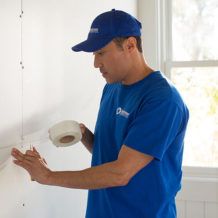
We are excited to announce that a long time Master Craftsman of our business is now the proud new owner; please join us in congratulating Earl Swader as the new owner of Handyman Connection of Blue Ash. Earl has previous business ownership already under his belt and is looking forward to continuing to serve the Blue Ash community as the proud owner.

Roofing / September 24, 2026

A roof can appear completely undamaged from the street, remaining intact with zero visible cracks or displaced materials. Water still finds a way inside your home, creating damp spots on ceiling drywall during heavy rainstorms.
Finding the exact entry point requires patience and methodical inspection steps. Small gaps around structural seams or underneath surface materials direct water far away from where it drips inside.
Water travels along rafters and roof deck framing before dropping onto ceiling joists. Tracing stains back to the highest point gives you a clearer starting location during a wet weather event.
Staining on the underside of roof sheathing points toward hidden moisture paths. Professional contractors specializing in tile roof leak detection direct their attention toward dark wood discoloration or rusted nails. Damp insulation below these points indicates active pathways that require immediate repair. Checking dark corners with a bright flashlight reveals wet trails along framing timber.
Sloped rafters can carry streams 5 or 6 feet across a room before letting water drop onto drywall. Looking straight above a ceiling spot leads to wrong conclusions. Following the wet path upward pinpoints the true origin.
Surface components on a residential roof act mostly as shed shields rather than total waterproofing barriers. Water penetrating beneath upper layers encounters secondary membranes designed to redirect moisture down toward perimeter gutters.
An industry guide points out that components like underlayment, flashing, and fasteners sit beneath surface tiles to keep structures dry. When aging felt paper degrades or tears, water slips past without disturbing outer surfaces. Aging fasteners can loosen, creating tiny pinholes where moisture collects gradually.
Debris accumulation beneath upper materials holds damp leaves against protective felt layers. Trapped dampness speeds up material breakdown across 2 or 3 seasons. Clearing accumulated pine needles helps prevent premature underlayment decay on older installations.
Metal flashing around chimneys, vent pipes, and skylights creates vulnerable transition joints across roof slopes. Sealants along these metal edges shrink after hot summer months, leaving thin gaps where wind pushes rainwater inside.
A home maintenance publication notes that attics frequently serve as the initial location where visible roof leakage manifests. Inspecting pipe boots and chimney saddles after heavy storms catches tiny drips early. Common penetration points to inspect include:
Cracked caulking along metal collars allows driving rain to creep behind flashing edges smoothly. Replacing dried sealant restores water protection without requiring full structural overhauls. Regular checks keep seal joints performing properly.
Visual inspections fail to locate microscopic punctures in flat or low-slope roof sections. Standard flood tests risk causing interior water damage if waterproofing membranes contain large hidden gaps or tears.
A technical roofing report highlights that high-voltage testing offers rapid and accurate defect detection in waterproofing membranes without needing water flooding. Technicians sweep non-destructive electrical currents across membrane surfaces to detect tiny breaches instantly.
Electrical detection equipment alerts operators to grounded connections where moisture bridges membrane layers beneath surface caps. Finding hidden membrane tears saves time and prevents unnecessary material tear-offs during building maintenance.
Uncovering hidden roof leaks requires looking beyond visible surface tiles or shingles. Checking attic spaces, underlying membranes, flashing joints, and testing options narrows down tricky moisture entry points effectively.
Addressing minor seal gaps early prevents costly structural repairs inside ceiling frames. Regular inspections keep homes dry and protected throughout every season.

11115 Kenwood Rd.
Blue Ash, OH 45242

© Handyman Connection 2026 | Privacy Policy

 (513) 771-3950