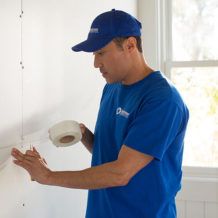
We are excited to announce that a long time Master Craftsman of our business is now the proud new owner; please join us in congratulating Earl Swader as the new owner of Handyman Connection of Blue Ash. Earl has previous business ownership already under his belt and is looking forward to continuing to serve the Blue Ash community as the proud owner.

Roofing / July 2, 2026

A commercial flat roof can last anywhere from 15 to 40 years depending on the system chosen, but that range means little if installation is handled poorly. Across commercial roofing projects, workmanship is consistently the biggest variable separating a roof that performs for decades from one that fails within years.
Proper installation affects nearly every performance factor that matters. Seam integrity, drainage slope accuracy, flashing durability, and membrane adhesion all depend on how carefully the system is applied, not just what materials were used. Even a high-grade roof membrane installed incorrectly will develop leaks, pooling, and edge failures long before its rated service life.
That gap between potential and actual performance is what makes installation quality so consequential for facility managers and property owners. The NRCA PROCertification program exists partly because of this reality, setting standards that recognize contractors who meet documented competency benchmarks. Beyond performance, manufacturer warranties for most flat roof systems require installation by approved contractors following approved methods. Skipping that requirement does not just risk the roof; it often voids the coverage protecting the investment entirely.
Commercial flat roof systems typically span a wide lifespan range, and installation quality is the single biggest variable within that range. A roof membrane applied with consistent seam welds, accurate drainage slope, and properly terminated flashing will consistently outperform the same material installed carelessly, regardless of how premium the product is.
The installation factors that most directly affect longevity include:
Manufacturer warranties reinforce this point. Most flat roof system warranties require installation by approved contractors following approved methods, and deviating from those requirements can void coverage entirely.
Every flat roof involves the same core components: a membrane on top, insulation beneath, a deck underneath that, and flashing wherever the surface meets edges, drains, or penetrations. TPO, EPDM, PVC, modified bitumen, and BUR all behave differently as materials, but every one of them depends on correct system assembly to reach its rated lifespan.
Changing any one layer changes how the others perform. Undersized roof insulation creates thermal bridging. Poor substrate preparation causes adhesion failures. Inadequate vapor control leads to moisture accumulation that degrades the system from underneath, long before visible surface damage appears.
Most flat roof failures do not originate at the center of the membrane. They begin at transitions: where the roof meets a parapet wall, where a pipe or HVAC unit penetrates the surface, or where the field of the roof connects to an edge detail.
Flashing at these points takes the most mechanical stress from thermal movement and wind pressure. When these details are not sealed and terminated correctly during installation, they become the first place water finds a path inward.
The choice between a mechanically attached and a fully adhered installation method carries consequences beyond the installation day itself. A mechanically attached flat roof system allows more membrane movement over time, which places recurring stress on seams as the material expands and contracts with temperature changes.
Fully adhered systems reduce that movement, keeping seams under less ongoing stress. The tradeoff is that full adhesion demands more precise surface preparation, and any contamination or inconsistency in the substrate affects bond quality across the entire field.
These decisions, made during installation, also shape drainage slope, how thermal movement is managed across the roof deck, and how accessible the system will be for future repairs. In the Greater Toronto Area, contractors such as the Seam Roofing crew factor in all of these system-level variables when specifying attachment methods for a given commercial roof, treating membrane, insulation, flashing, and attachment as one coordinated assembly rather than a series of independent steps.
Most early failures appear at details rather than in the open field of the membrane. The field is where installers spend the most time and attention; the transitions, terminations, and penetrations are where shortcuts tend to accumulate. Understanding where those shortcuts lead is the clearest argument for getting installation right the first time.
Poor heat-welded seams are one of the most common workmanship failures in commercial roofing. When seam temperatures are inconsistent during welding, the bond is weak even if the joint looks complete from the surface. Those weak points open under thermal cycling and eventually allow water infiltration.
Flashing transitions present a similar risk. Where the membrane meets a parapet, curb, or edge termination, the material must be secured and sealed in a specific sequence. Contractors who rush these transitions or skip primer steps leave gaps that expand over time as the roof moves with temperature shifts.
Penetrations, where pipes, drains, and mechanical equipment pass through the membrane, require precise detailing to maintain a watertight seal. Sloppy collar work or improperly cut membrane around these points creates immediate vulnerability, regardless of how well the field membrane was installed.
Water management failures often trace back to decisions made before the membrane goes down. Poor substrate preparation, such as laying materials over an uneven or contaminated deck, prevents proper adhesion and leaves voids where moisture can travel laterally beneath the surface.
Misapplied roof insulation compounds this problem. When insulation boards are not properly offset, tapered, or secured, they shift and create irregularities that interrupt drainage flow across the field.
Ponding water is typically the most visible consequence. When slope planning or drainage system design is inadequate, water pools and stays, softening the membrane, adding structural load, and accelerating deterioration well ahead of the roof’s expected lifespan. These are preventable workmanship issues, and consistent roof maintenance is the most reliable way to catch them before they compound into larger failures.
A well-installed commercial roof still requires consistent attention to hold its performance over time. Scheduled inspections and routine roof maintenance allow facility managers to catch minor membrane separations, blocked drains, or flashing movement before they compound into failures that shorten roof lifespan significantly.
Climate stressors reinforce why early installation decisions matter throughout the ownership cycle. UV exposure, temperature swings, wind uplift, and standing water all place ongoing stress on the system. A drainage system that was properly sloped and detailed from day one handles those stressors far better than one corrected after the fact.
However, maintenance extends the value of quality work but cannot fully rescue a flat roof system that was poorly installed. Consistent upkeep buys time on a sound foundation; it does not substitute for one.
Documentation also plays a practical role in long-term performance. Punch-list completion, warranty compliance records, and installation sign-offs create a traceable history that matters when a commercial roofing warranty claim is filed or when ownership changes hands. For broader home improvement and repair insights that touch on maintenance planning, those records are consistently among the most overlooked assets a property owner holds.
Material selection is only half of what determines how long a flat roof performs. Whether the system is TPO, EPDM, PVC, modified bitumen, or BUR, the membrane itself does not deliver its rated lifespan without correct assembly, properly detailed transitions, accurate drainage slope, and consistent follow-up care.
A durable flat roof system is built through execution, not just specified on paper. Facility managers working with reliable local handyman professionals know that the decisions made during installation shape every maintenance cycle that follows.
Choosing the right material matters. Getting the installation right is what makes that choice count.

11115 Kenwood Rd.
Blue Ash, OH 45242

© Handyman Connection 2026 | Privacy Policy

 (513) 771-3950