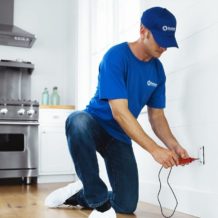
We are excited to announce that a long time Master Craftsman of our business is now the proud new owner; please join us in congratulating Earl Swader as the new owner of Handyman Connection of Blue Ash. Earl has previous business ownership already under his belt and is looking forward to continuing to serve the Blue Ash community as the proud owner.

Electrical / April 10, 2026

If your home seems unusually dusty, allergy symptoms flare indoors, or your heating and cooling feel inconsistent, one possible cause is a neglected HVAC filter. Many homeowners treat the HVAC filter as a minor maintenance item, but it plays an important role in protecting the system and maintaining airflow. But in reality, regular air filter replacement is fundamental maintenance with impacts on both comfort and mechanical function.
The primary job of a standard HVAC filter is to protect the equipment, although it can also help reduce airborne particles depending on the filter type. When clogged, the filters severely restrict airflow. The blower may have to work harder and the system can run less efficiently, which may increase energy use and place added strain on components. More commonly, a clogged filter creates excess pressure drop and reduces airflow through the system. Dirt buildup on internal components is more likely when the filter is missing, poorly fitted, or allowing air to bypass around the edges. Neglecting this simple maintenance task can contribute to higher energy bills, extra mechanical strain, reduced airflow, and less consistent comfort indoors. Ensuring your system is running efficiently is a key part of seasonal home maintenance and long-term HVAC health.
For many residential systems, a common rule of thumb is to inspect or replace standard filters every 30 to 90 days, but the correct interval depends on the filter type, system use, and household conditions. Trying to set a hard and fast universal rule would be a mistake, as different filter types have different capacities for catching dirt before restricting airflow.
To maintain the mechanical equipment at peak efficiency, here’s how to decide based on the thickness and material of the filter:
On newer whole-house systems, always check the filter cabinet or manufacturer documentation before assuming a standard 30-day replacement schedule. Some systems use high-capacity media filters with very different maintenance intervals.
Things like the baseline timelines above are really just ballpark suggestions. You really need to tune the HVAC filter replacement schedule to the home’s environmental loads. In other words, the dirtier the air, the faster the rate.
All of these can add more particles to the air, which may cause the filter to load up faster than normal.
Here are some factors:
Filter dirt pickup only happens when the system runs. When there is heavy usage in summer A/C and winter heating days, this means more air passes through the filter and picks up dirt faster. By contrast, a lightly used vacation home may allow longer intervals between changes, but the safe timing still depends on the filter type and manufacturer guidance.
MERV measures how effectively a filter captures particles; it is not determined by thickness alone. Higher-MERV filters can create a greater pressure drop, especially if the HVAC system is not designed for them, so filter selection should match the equipment’s airflow requirements. So you can’t just leave them in there forever without damaging the fans and systems. Thicker ones basically give you surface area that works both for higher MERV levels and longer timelines.
Sometimes the schedule above needs to be thrown out the window because the following 5 physical signs on your air filter indicate you should throw it out and replace it early to protect the mechanical equipment from strain:
Yes, learning how to change an HVAC filter is important as a skill to protect your mechanical equipment.
Here are the steps to do it correctly:
Do not guess on a replacement filter size/model/type. Many homeowners have incorrectly jammed wrongly sized filters into slots, leading to bypass and lost protection.
The easiest place to start is the size printed on the existing filter, the filter cabinet label if present, or the equipment documentation. The furnace or air-handler nameplate usually identifies the HVAC unit itself, not always the exact replacement filter model. While many systems will take traditional generic 1-inch filters on their returns, many whole-house central HVAC units specify proprietary media filters instead. These need to be carefully matched so that they seal correctly and don’t overly restrict the system. For example, many homeowners trying to resolve replacement options for specific systems like AprilAire 2210 and 2216 will consider the Aprilaire #213 as a replacement for the AprilAire 2210 and 2216 systems. The key is physics and engineering compatibility so that it slides into the tracks properly, forces all the air through the filter media, and otherwise protects your HVAC system from damage.
These maintenance steps require immediate action, not waiting until the house gets uncomfortable or the HVAC system prematurely dies.

11115 Kenwood Rd.
Blue Ash, OH 45242

© Handyman Connection 2026 | Privacy Policy

 (513) 771-3950